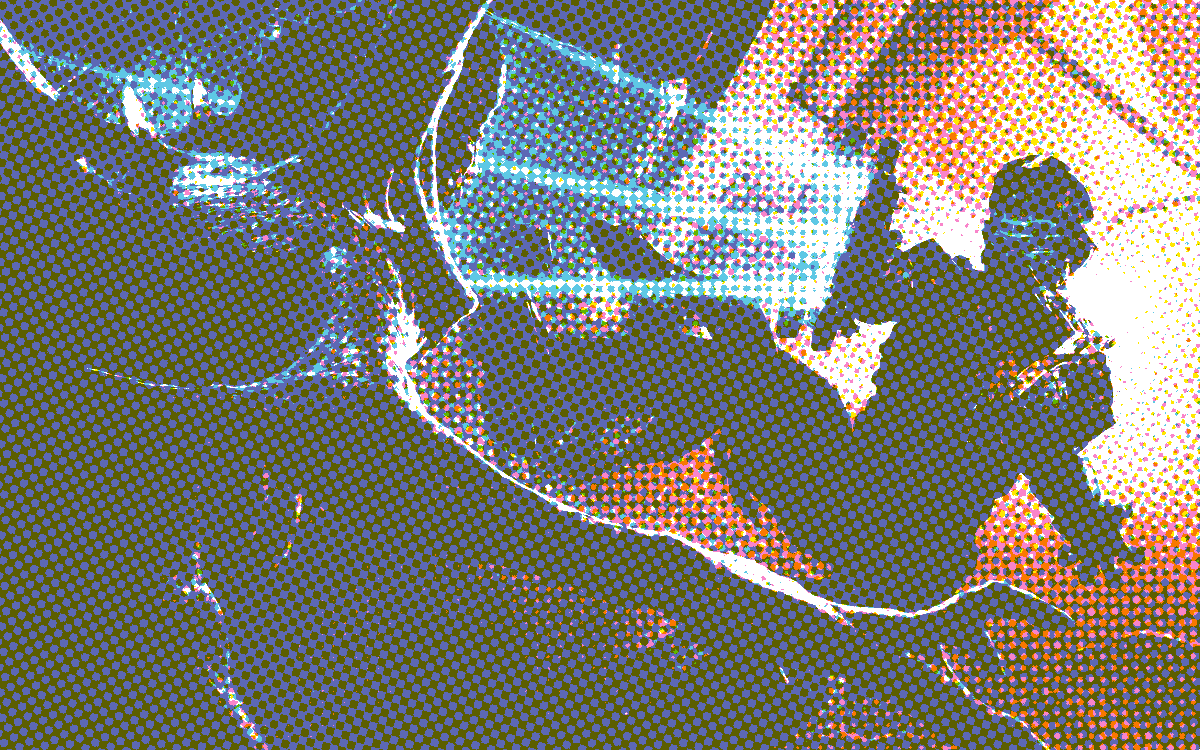
An armor-clad Isaac falls backwards while shootin, pursued by an alien.
Chase Sequences

Words by  Toussaint Egan

Chase Sequences

Stalked by Survivor's Guilt in Dead Space 2

Words by  Toussaint Egan

Every moment of Dead Space 2 feels like you’re fighting to cheat death. From the game’s opening moments, protagonist Isaac Clarke narrowly skirts the edge between life and death as he’s thrust into a heart of a necromorph infestation aboard “The Sprawl,” a civilian colony chiseled out of Saturn’s former moon Titan. As if those horrors weren’t enough, Isaac is plagued by nightmarish visions of his late wife Nicole, forcing him to question his own sanity while grappling with the burden of trauma left over from having narrowly escaped the USG Ishimura with his life three years prior.

There are innumerable encounters in Dead Space 2 that, however violent and brief, would qualify as chase sequences. The aforementioned opening, for example, where a delirious and straitjacket-bound Isaac must escape from an asylum whose patients are being devoured and transformed into a new brood of necromorphic predators. When I think of a truly exemplary chase sequence, however, that honor is reserved for Dead Space 2’s finale - and a creature whose nature and lethality more than warrants the distinction of its name.  
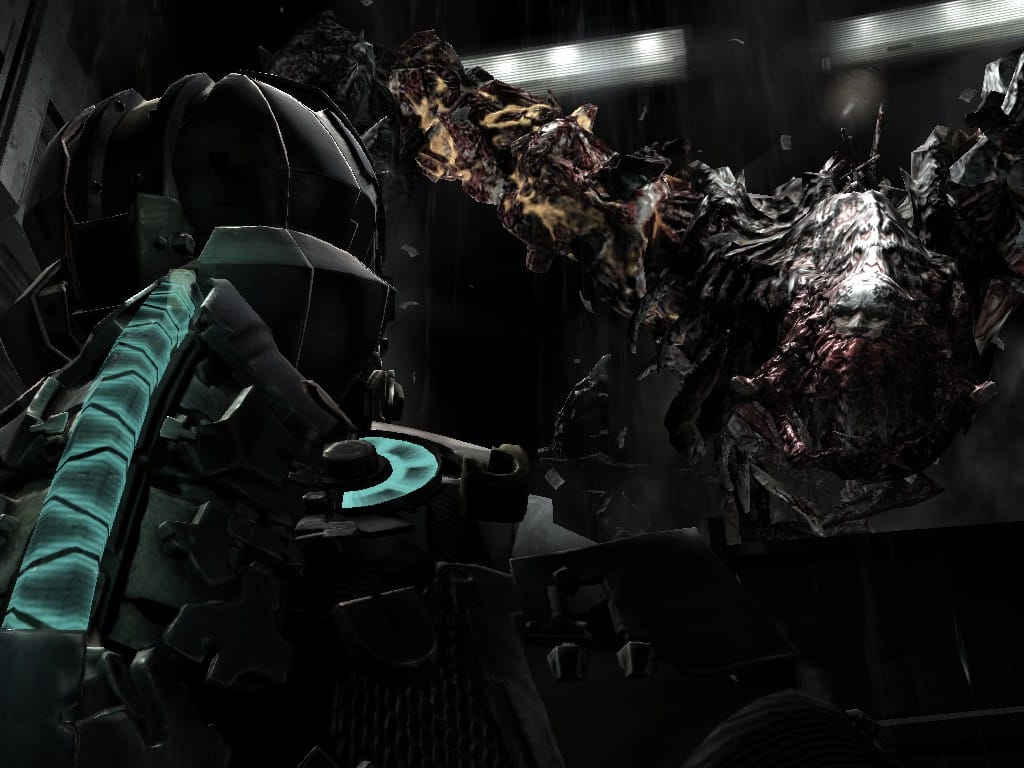
A grotesque monster with insectoid legs and a human face towers over the player.

In the fourteenth and penultimate chapter of the game, Isaac comes face to face with the Marker: an extraterrestrial object whose psychic energy triggers a cataclysmic chain reaction across the Sprawl, twisting any form of sentient life into shambling husks of living death. At the behest of a vision of Nicole, Isaac must battle his way through waves of necromorphs to reach the base of the Marker and destroy it. There’s just one problem: the Ubermorph, a necromorph with the ability to regenerate itself after being otherwise destroyed, stalks him every step of the way. No weapon at your disposal — however powerful or surgical — can hope to stand a chance against this adversary. In order to survive, you have to put as much distance between yourself and it while dispatching an onslaught of necromorphs as you make your way to the Marker.

Dead Space 2 protagonist Isaac Clarke stands before a flaming alien structure.

Video game chase sequences, by their nature, are defined by momentum and brevity. They seldom last longer than a single level and more often than not consist of some variation of real-time button prompts and obstacle traversal — or at least, they do in contemporary titles. While the Ubermorph encounter spans a single location (a clandestine EarthGov research facility), the experience as a whole is divided across two chapters of the game, ratcheting up the tension and prolonging the experience of fending off your would-be pursuer. The Ubermorph chase involves more than simply outrunning your opponent, but navigating the assorted hallways and laboratories between you and your destination, mowing down enemies while simultaneously scavenging for ammunition as you keep one eye open for a terror that cannot be killed by earthly means and will not stop coming, no matter what.

It’s a tense and narrow battle of attrition, laying waste to wave after wave of the undead, all the while fighting desperately against an opponent who cannot die. When running low on ammo, it’s tempting to race past whatever necromorphs you’re fortunate enough to outwit and outpace, or blast them with a stasis module to temporarily freeze them in place before frantically bludgeoning your way through them. It’s an uncommon take on the traditional video game chase sequence — one which lasts however long the player themselves is willing and able to endure. An agonizing death march of a thousand serrated cuts.

The immediate question at that moment, then, is obvious: how do you kill something that doesn’t die? For the player, the Ubermorph is just one more permutation of the homicidal, shapeshifting biomass that’s hounded them from the start. Yet within the larger context of the game — and of Isaac’s personal arc — the Ubermorph can be interpreted as an allegory for the survivor’s guilt that’s haunted him at every turn in the form of Nicole’s eerie taunting visage, and for the regret of having been unable to save her all those years ago. The question, then, takes on a different shape: how do you forget a trauma that has fundamentally reshaped the trajectory of your life? From there, the answer is simple: what you cannot kill, you must find a means to contain; what you cannot forget, you must learn to live with.

After taking an elevator to the final gangwalk to the Marker and passing by the game’s last optional save station, you’re ambushed one last time by the Ubermorph in a narrow hallway adjacent to a quarantine chamber. Upon luring the beast inside and temporarily incapacitating it by severing all of its limbs, the player is able to break the remaining fuse powering the chamber’s door, sealing the Ubermorph inside and finally preventing it from posing any further threat. The dead don’t die easily, but it’s certainly harder to argue that from the inside of a closed casket.

The Ubermorph, a slimey grey spider-like creature with glowing eyes and pincers, crawls towards the player after having several limbs shot off.

The Ubermorph chase sequence is the denouement to Dead Space 2 and an exemplary set piece that brings the full horror of Isaac’s odyssey across the Sprawl to its climax. As with the creature itself, Isaac will never be fully rid of the weight of his loss and the burden of having survived the hell let loose in the wake of the necromorphs. Even so, there’s a peace in knowing that in spite of everything, there is a future and a life on the other side of all that terror — if one so chooses to seize it. There’s no shortage of exhilarating moments and set pieces that stand out in my mind in the near decade and a half since I first played Dead Space 2. That the terror and exhaustion of the Ubermorph chase encounter remains as resolutely clear in my memory now as when I first played it is a testament to the craft and novelty of its invention.


If you're on the hunt for more thrilling articles articles like this one, sign up for the Eteo Archetypes newsletter. You'll get the weekly Archetypes article in your inbox, plus important studio announcements from Eteo. And best of all, it's free!

Don't forget you can join the Eteo Discord server to discuss this piece and other Archetypes articles in a friendly and thoughtful environment.