The Impossible Final Boss of Star Wars Jedi: Fallen Order
Chase Sequences

Words by  Emma Kent

Chase Sequences

The Impossible Final Boss of Star Wars Jedi: Fallen Order

Words by  Emma Kent

You’ve learned the abilities, practised them endlessly, and have the muscle memory to use them without thinking. You’ve explored every inch of the map, absorbed every power-up, and stuffed every weapon you can find into your backpack. Yes, you’re nearing the end of the game ‒ and you’re feeling fully in control of your character. Typically, this is a time when a game presents you with its toughest challenges, while giving you a moment to appreciate just how far you’ve come. The menacing mounted knight that once gave you so much grief? Gone in two bonks. The oversized flies that stubbornly blocked your progress? Easier to squash with a riot shotgun. The final stages of a video game often function as a power fantasy, with your evolved abilities acting as a metaphor for how much your character has grown on their journey. These abilities can sometimes feel a little indulgent, satisfying the player’s wish for extravagant levels of power. And there’s no better example of this than the final boss fight, where ‒ after a challenging struggle ‒ you defeat the big bad, wrap up the storyline, and end the game feeling as powerful as a god. 

Not so, in Star Wars Jedi: Fallen Order. Here, the only way to beat the final boss is by running away… and you’re given a serious humbling in the process. 

Let me set the scene here. In Fallen Order, you play as Cal Kestis: a former Jedi Padawan who’s on the run from the Galactic Empire. Following an epic journey that spans planets and solar systems, Cal ends up in a sinister underwater bunker, where he’s on the hunt for a device containing important data. Sure enough, things initially seem typical of a final level: you obliterate multiple ambushes, send platoons of underpaid stormtroopers to their deaths, and defeat an entire Sith dojo containing every annoying enemy in the game. Then, you’re presented with a big combat challenge in the form of Sith Inquisitor Trilla, who provides a scrappy and intense lightsaber duel. Her defeat should signal your total victory, and position you as no.1 lightsaber wielder in the galaxy. But here comes the twist. Darth Vader shows up. He swiftly dispatches Trilla. He swats aside your mentor, and turns to deal with you. He has no health bar. You cannot damage him. All you can do is run.
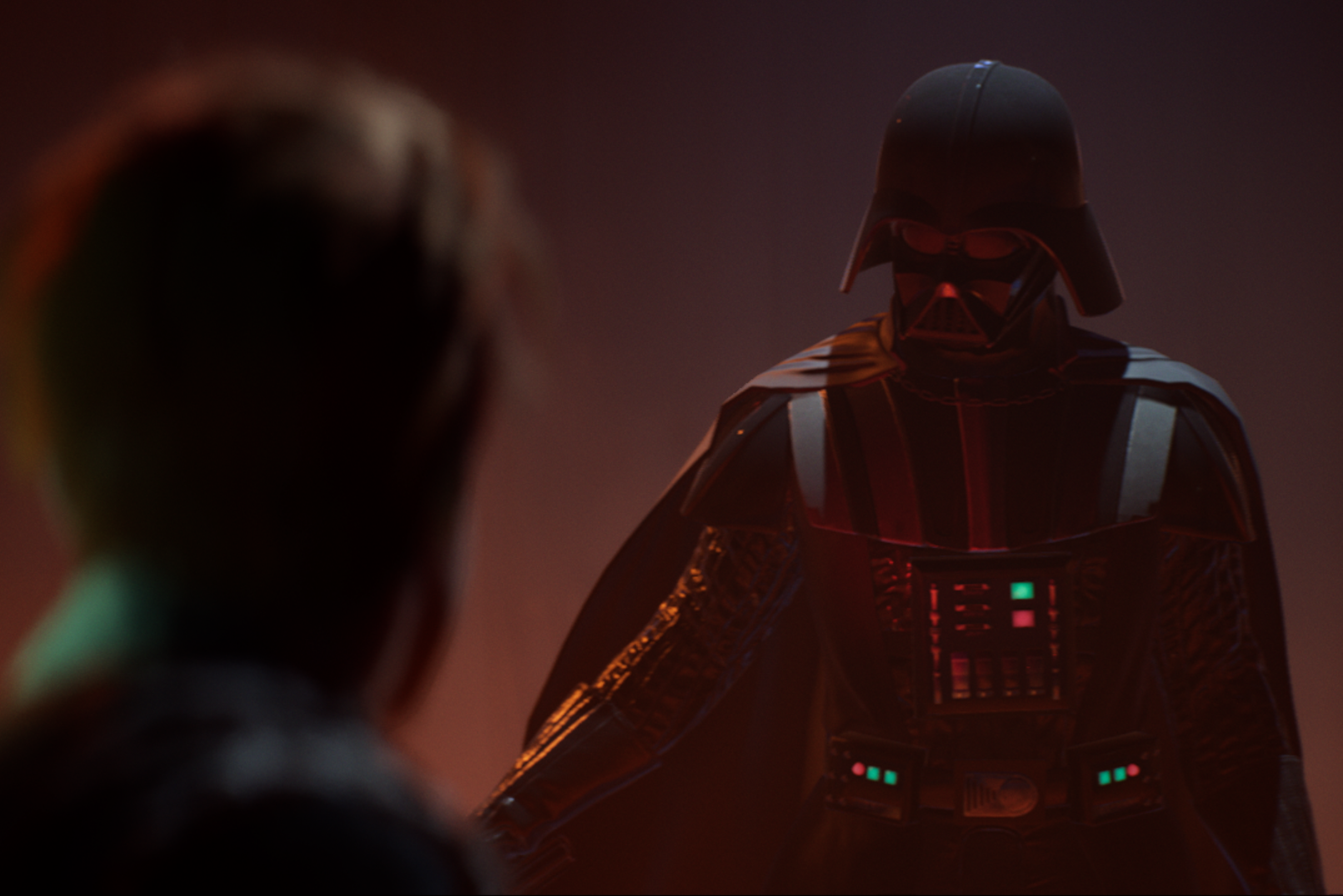
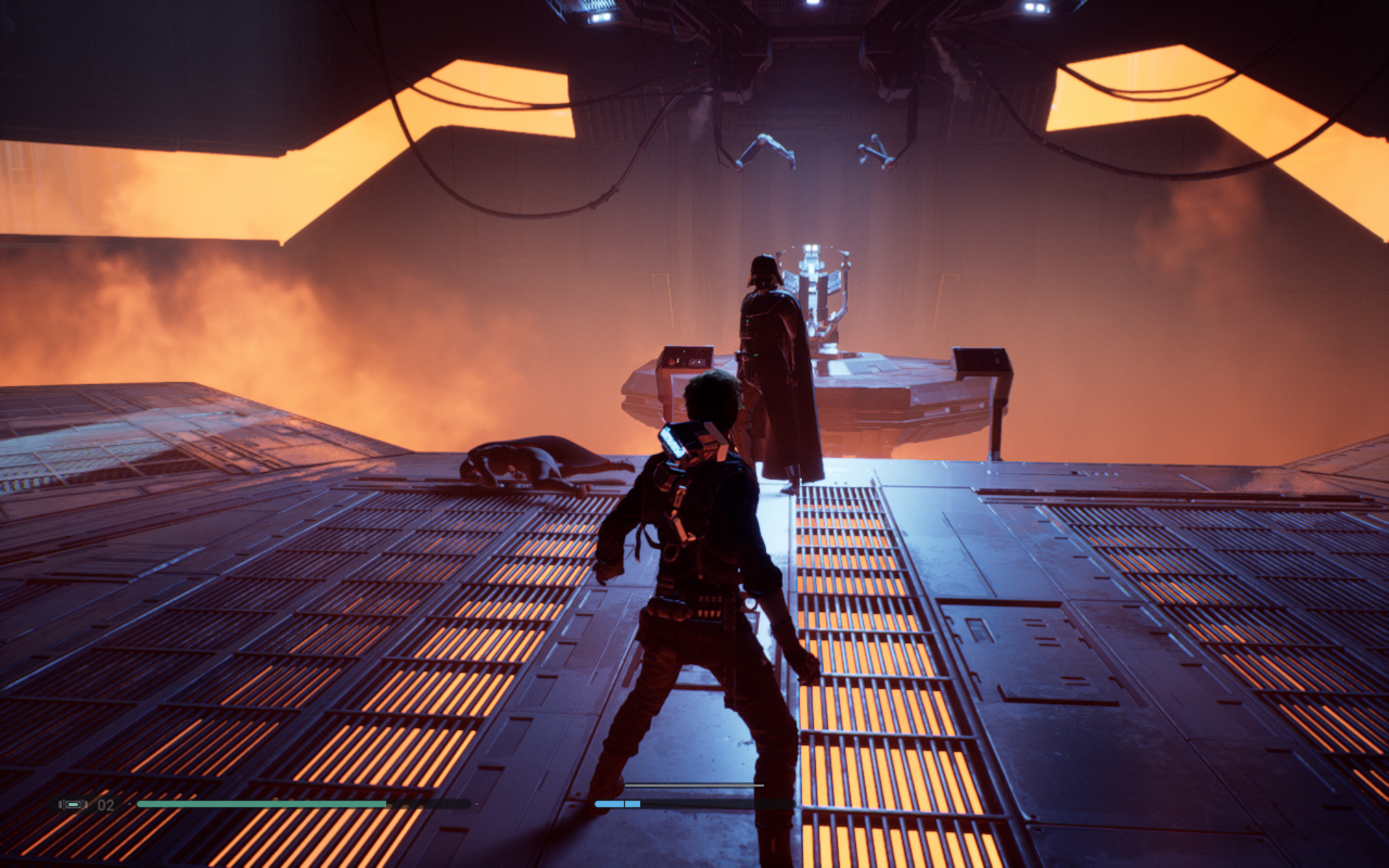
It’s a devastating introduction, and the subsequent chase sequence is a far cry from the typical power-fantasy boss fight you’d expect to find at the end of an action game. Yet flipping the stereotypical power arc on its head makes total sense for Fallen Order’s story. At its heart, this is a narrative about a young person recovering from trauma: a growth process that is gradual, not immediate. 

During his adventures in Fallen Order, Cal slowly rebuilds his connection to the force, working through his trauma to remember his Jedi training. Through doing so, he steadily recovers his powers and sense of identity. This is a journey that Cal has only just begun, however, and the Vader chase sequence serves to remind us of this fact. In video games, power and combat abilities often act as shorthand for a character’s personal growth on a narrative level. Allowing Cal to dominate everything in the game would have falsely imparted the impression that his personal journey is ‘complete’ by the end of Fallen Order. Instead, facing the might of Vader serves as a reality check for the player, reminding them that Cal is not yet fully developed. Although he’s made great progress, there’s plenty of room for further growth here, both as a Jedi and person. Sure enough, this also sets things up for Fallen Order’s sequel, where Cal continues to deal with the Empire and the long-term effects of trauma.

Though the chase sequence shows us Cal still has some growing to do, it also (somewhat paradoxically) acts as a sign of Cal’s increased maturity. Recognising when you’re outmatched is a skill in itself, and Cal’s decision to run ‒ rather than risk dying a fruitless death ‒ displays some much-improved decision-making. With important data in his possession and friends back at the ship, Cal now has more hope and purpose in his life, and a reason to want to survive. By forcing you to flee, Fallen Order argues that you should choose your battles carefully. Dying a hero achieves nothing: the smarter decision is to run and fight another day. And sure enough, Cal’s growing wisdom is further demonstrated by his eventual decision to destroy the data, rather than risk it falling into the wrong hands. 

Beyond mirroring Cal’s personal journey, the chase sequence also brings an air of menace to Fallen Order that sometimes feels lacking in certain adaptations of Star Wars. Don’t get me wrong - it’s incredibly fun to obtain ridiculous force powers and hop around as a veritable death machine in SWTOR and The Force Unleashed. But these powers can sometimes make you feel a little too comfortable. Being helpless against Vader presents the true horror of facing a Sith Lord, and gives you an idea of what it feels like to be on the receiving end of his wrath. It’s an experience that echoes Rogue One’s brilliantly claustrophobic corridor sequence, where Vader is presented as a hulking monster who strikes down all before him.

Fallen Order similarly presents Vader as a Resident Evil-style monster: an unstoppable force willing to destroy anyone, and anything, in order to achieve his goals. While running away as Cal, platforms twist under your feet, metal grates are thrown at your head, and unlucky stormtroopers are toppled into the void below. Vader’s lightsaber slices through elevator doors, and just when you think you’ve escaped, he appears again to block your exit. This sense of destructive, unrelenting force ‒ and Vader’s callous disregard for his minions’ lives ‒ underlines just how nasty and threatening the dark side really is. Fallen Order’s chase sequence is good old-fashioned horror, and its placement at the end of the story makes it feel particularly unexpected. It’s a sort of wake-up call, as if to say: don’t you dare imagine that the Empire can be defeated that easily. There’s work to be done yet. 

Darth Vader, shown in near darkness and illuminated by red and blue lighting.

The Vader chase sequence puts Cal’s journey of growth into perspective: he is not yet a master, and is very much still a work in progress. It’s a reminder of the full force of the Empire, and the terrifying Sith Lord at the heart of it. And, more than anything, it shows that there’s wisdom in knowing when you’re beaten. In the face of dealing with something totally out of your league, it’s okay to take a step back, work on your skills, and return ready to take on something more on your level. Because if your opponent is Darth Vader… well. That might just be a challenge for another day.


You've escaped the clutches of Darth Vader - why not wind down by signing up for the free Eteo Archetypes newsletter. You'll get the weekly Archetypes article in your inbox, plus important studio announcements from Eteo.

Don't forget to join the Eteo Discord server to discuss this piece and other Archetypes articles in a friendly and thoughtful environment.