Seasons
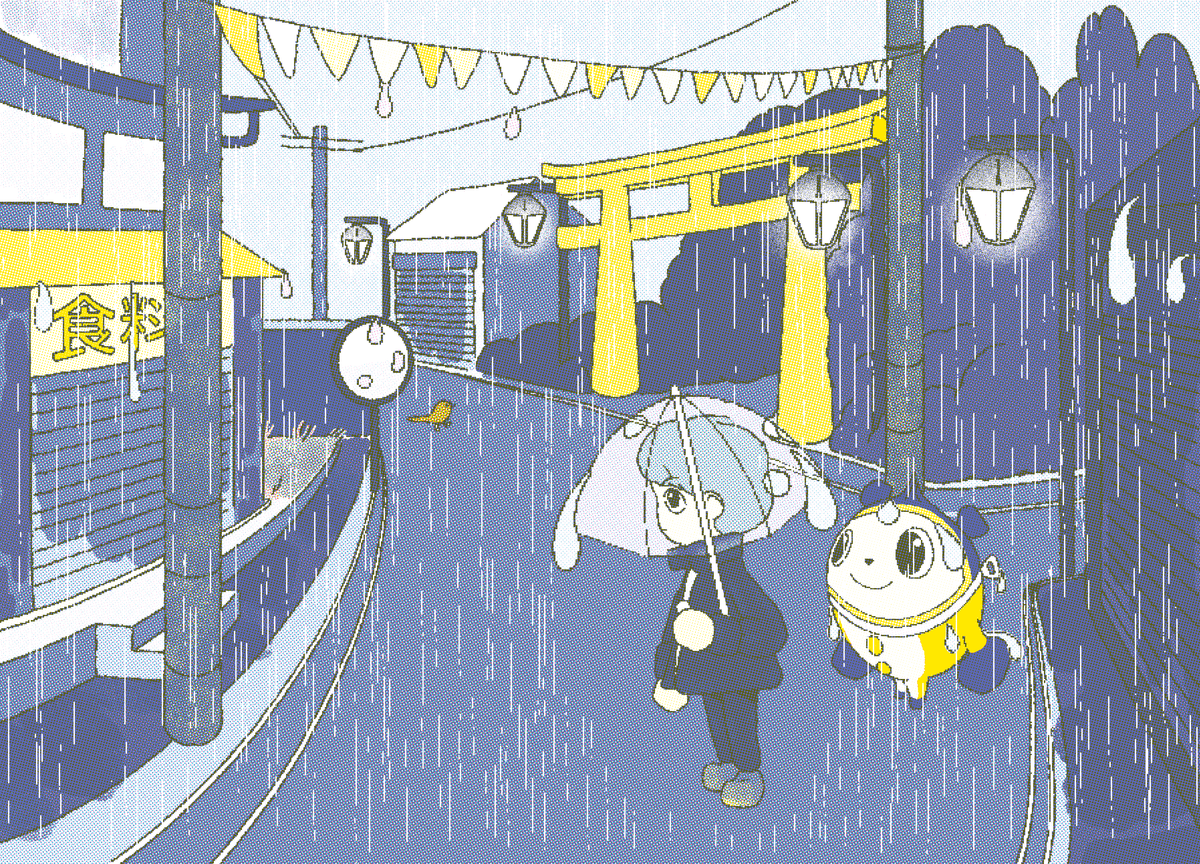
Passing Time in Persona 4's Tourist Town
I grew up going to vacation towns on the coast in the off-season. Locked-up boat sheds, storm-clouded beaches, and glasslike seas decorate some of my happiest memories. There’s pleasure in being an off-season tourist. Summer tourists go without artifice, as themselves; in winter, tourists are undercover as locals. Even though you’re not from a place, for a while, you can pretend you are.
Persona 4’s Inaba doesn’t have an off-season exactly, because it’s always off-season. A small town plagued by mysterious fog and serial murders – the two, it turns out, connected – Inaba’s options for fun are hanging out at the megastore and fishing. You’re a visitor staying with family, but at the same time you get to be from here: you go to school for a whole year. You’re neither a delinquent nor an outcast, but a well-liked kid who only needs to schmooze a little to really be popular. The town’s annual events, spaced out like diamonds on a crown, show you an aspect of rural beauty in each seasonal facet.
Yet like a real vacation town, Inaba reserves itself from you, making you work to really see it. It changes with the seasons and adds and removes opportunities as they progress, giving and taking away events, quests, connections, and even clues in the murder case. Becoming familiar with Inaba through its many changes ends up being an important part of solving its mystery. That hard-won familiarity also teaches the player that careful attention to detail is important and that how you use your limited time matters ‒ a theme of the Persona series as a whole.
Persona 4 is now (until its remake comes out, anyway) the oldest game in the main Persona series and the least convenient to play. It lacks many of the concessions Persona 5 and Persona 3 Reload make for player ease. For example, simple actions like persona fusion are more inconsistent, and side quests depend on unpredictable RNG. Persona 4 also blocks out large parts of your summer and winter break for The Plot, leaving you scrambling to kiss your girlfriend or force the relationship with a Rank 6 connection before time is up.
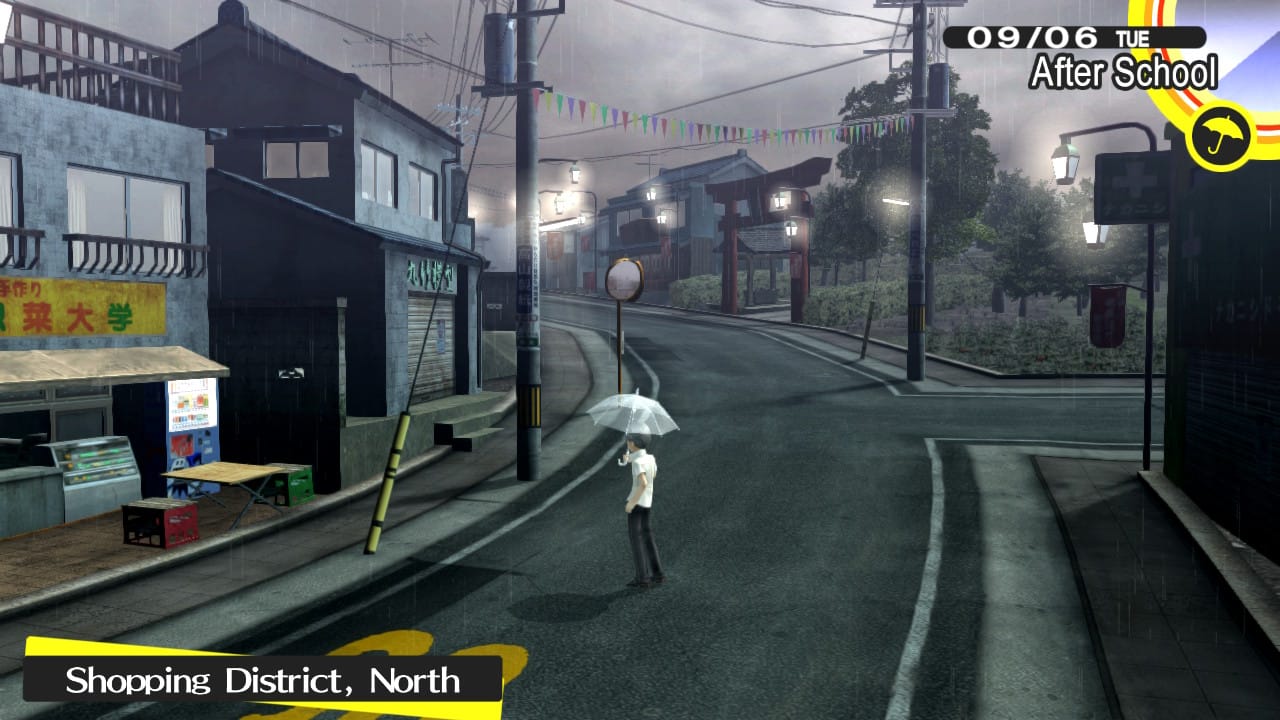
This unease of access extends to the town as well. I challenge anyone to know, without looking up a guide, which evenings the bar is open or when you can visit Okina City. Persona 4 dares the gamer of 202 not to use a walkthrough. It is completely ok with letting you miss whole social links, areas, and even the secret ending that lets you play Golden’s extra dungeon. And forget about finding who’s available when; unless someone calls you, you have to walk to their spot to find out if they want to hang out, or if they don’t because it’s a Wednesday, or it’s raining, or – oops! – you joined the wrong sports team. Shops in town also open and close through the year. The tofu shop opens and becomes interactable in the summer when pop star Rise arrives. Some stores are uninteractable for the whole game, like the always-closed bike shop. Others are closed when the weather’s bad, or they offer specials. Some days, your uncle won’t even let you go outside.
Persona 4 doesn’t have seasonal employment, strictly speaking, but it does have jobs tied to social stats that only reach higher levels in the summer and fall. In spring, you’ll be folding cranes and helping out at the daycare; in summer, you might have graduated to working at the bar; and by fall you can tutor. These jobs also have social links attached, meaning who you hang out with might change with the seasons, too.
Every Persona game has some of these restrictions, but in Persona 4 they’re more present because of Inaba’s rural setting. People comment on events they’re looking forward to like festivals or school trips; the arrival of a celebrity in town is conversation material for a month. While Persona 5’s Tokyo has useful destinations (or at least distractions) around every corner, and Reload’s refreshed Tatsumi Port Island is bustling even in comparison to 5, Inaba is kind of empty. It’s obvious when the tree at the end of the river road changes colors in the fall– you walk by it so often it’s practically a landmark. The arrival of cicadas at the shrine in summertime is deafening compared to the relative silence before. You really notice when Inaba is changing, and because each season is distinct, completing one section of the game often means leaving behind whatever you were unable to finish in the last one.
Yet no season leaves more of an imprint than summer. If you played Persona 3, you know fall is when it gets real; vacation episode in the bag, the unaware team must be struck by personal tragedy. Here you have a summer festival, a prank-filled summer camp, and long days of choosing which new friend to hang out with before that happens. The light gold summer sun, in contrast to the bright yellow of the TV (Persona 4’s signature color), suffuses each scene. I always thought ‘golden’ was the wrong color to describe the game’s fluorescent yellow theme, but it describes the summer light perfectly. Summer bakes in memories for you to look back on a few months later; it’s the time when everything was good, murder case aside.
A commonly-cited reason for playing Persona is nostalgia for high school. But people often speak about a fear of completing the games and their nostalgia for them once a playthrough is finished. In each entry, the protagonist ultimately departs their friends and new town, only pulled back for a DLC. Even halfway through the game, you can feel the ending coming. Persona 4 eventually becomes a slope down which you slide faster and faster, the murder plot overshadowing, though not completely, the more everyday things you could be doing.
The distinct seasons of Persona 4, its summer feeling meaningfully different from its winter, mean that you actually feel you’ve spent a year in this place at the end of it. But the seasonal restrictions of Inaba also convey a theme the other games in the series usually approach through words: the importance of using your time wisely. Persona 3 conveys this through the calendar, the first time the series used such a mechanic. Towards the end of the game, its characters muse on the extremely limited time it’s suddenly clear they have. The bottom corner of the loading screen in Persona 5 famously says ‘Take your time,’ a somewhat tongue-in-cheek reminder that you should enjoy yourself, but that every minute you do so is on the clock. Use your time, in other words, before it’s gone.
I couldn’t find such a firm statement of the series’ thesis in Persona 4. That’s because Inaba is the statement. Its distinct seasonal rhythms and empty spaces and circuitous, sometimes nonsensical schedules and requirements, the ways the town changes subtly through the year, all combine to make a game where every moment you spend really feels spent. In its final moments, when you have to choose between returning to your house (accepting a lesser understanding of the mystery you’ve been solving) or really, truly solving the murder case, Inaba’s springtime attractions are open to you again, implying that you could circle back to the beginning of the game if you could just delay the last choice a little longer. A second Spring in Persona 4 doesn’t exist, however. Having arrived in Inaba as a tourist, albeit a long-term one, you eventually have to leave.
As a series, Persona’s reputation and its essence contradict each other: known as a game where you can live your life as you wish, it's the hidden restrictions of time and place that make your choices feel meaningful. It’s a melancholy outlook, and one core to the series that none of its other entries has expressed so wordlessly and elegantly: take your time, really grab it, and spend it as you wish, before everything’s changed.
If you want a meaningful way to spend your weekends, why not sign up for the Archetypes newsletter. You'll get a weekly article straight to your inbox, along with any important Eteo game studio announcements. All for free!
Don't forget you can join the Eteo Discord server to discuss this piece and other Archetypes articles in a friendly and thoughtful environment.