Card Creation and Divination in The Cosmic Wheel Sisterhood
Minigames

Words by  Zack Wood

Minigames

Card Creation and Divination in The Cosmic Wheel Sisterhood

Words by  Zack Wood

I didn’t realize it at the time, but The Cosmic Wheel Sisterhood came out just as I was finishing my own deck of oracle cards in mid-2023. “Oracle cards” is the general term for cards used for divination ‒ similar to the more famous Tarot cards, which are made up of 78 cards in four suits, but more loose and customizable. A deck of oracle cards can have any number of cards with whatever words and images on them you want. For example, my deck contains 44 cards based on characters from past artwork.

I quickly got word of Cosmic Wheel from friends who knew I did oracle card readings ‒ and I do love a good mystical monster accompanied by a vibrant cast of pixelated characters. Once I finally got my deck printed and shipped and could sit down with the game, I discovered it to be pretty accurate when it came to simulating card creation and divination ‒ albeit with a number of intriguing twists.

The Cosmic Wheel Sisterhood puts you in the position of a witch who summons an otherworldly entity in order to create cards and do readings for all sorts of human-like characters . The people who visit Fortuna ‒ the main character of the game ‒ often become giddy with excitement when offered the chance to get a reading. I’ve similarly found that many if not most people I encounter are surprisingly eager to get readings even when it’s their first time, or they don’t necessarily seem like they’d be into something as ‘out there’ as card divination. If you think you don’t know anyone who’s into Tarot readings, you might be surprised. Tarot seems to have recently experienced a surge in popularity during lockdown, too, thanks to YouTube and Twitch. 
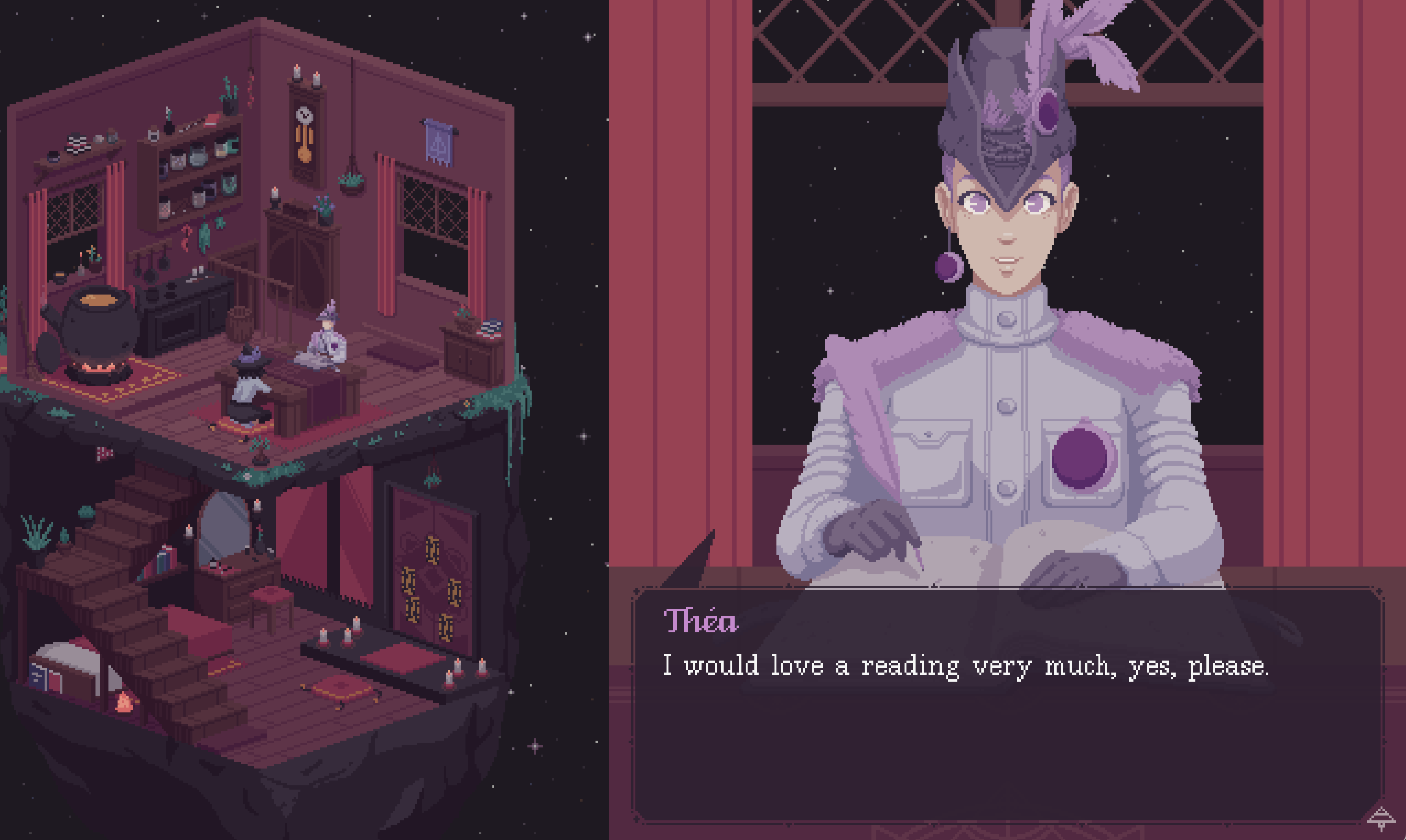
On the left a witch house floats in space, on the right a lady dressed in an opulent purple outfit says "I would love a reading very much, yes, please."

Many people both in real life and the game express some initial hesitation, but from my own experiences, I’ve found that this quickly melts away when a reading begins. I focus on light-hearted and helpful messages so I never have to decide if I should reveal horrible news. This is one area where The Cosmic Wheel Sisterhood differs a little, since it lets you dish out some pretty harsh messages. A real reading is less a matter of multiple choices and more of sifting through murky impressions to identify a core message. In-game dialogue, however, portrays your selection as the one and only message Fortuna receives, which is probably closer to how most readers would describe their own experience. Of course, offering dramatically different dialogue options (including some pretty negative ones) makes sense in a video game to keep things interesting and replayable, and a more intuitive and chaotic divination style is probably difficult if not impossible to simulate. Many card readers take a more systematic and logical approach than my own in the way they interpret cards, and some are much less concerned with delivering positive messages in a gentle manner. 

Cosmic Wheel sets up an interesting situation through its gameplay mechanics and story where Fortuna delivers some blunt one-liners during readings. In real life I might consider it a red flag if a tarot reader gave an intensely negative message but then said “Hey, I can’t choose the message! Don’t blame me!” The interesting thing about the game, however, is that the player does choose the message. What the player really seems to be controlling is the source of Fortuna’s intuition, choosing what vibe the cards suggest to her, which she can then honestly defend as ‘what the cards said.’ That’s a fascinating position to put the player in, and it makes me wonder about the possibilities of a game where interaction with the player-character revolves around vague impulses and impressions to guide them.

Three Tarot cards, called Rapture Dance, Toxicity and Lethargy. They depict exotic birds, a meteor hitting an ancient temple, and a boat sailing out over a purple sea at sunset.

If the player is acting as the source of Fortuna’s intuition ‒ and if the player chooses the card’s interpretations based on their real-life intuition ‒ then you could say the game is using the player’s own mind to simulate the source of divinatory messages. The ‘greater power’ behind divination is you, the player outside the game. If you take that as a metaphor for real life divination, then the game is suggesting the messages we get through divination are from a greater, meta world of entities at a level beyond our comprehension, who watch and guide our intuitive understanding of images and symbols. In fact, the game actually touches on this idea in one option where Fortuna informs characters that they exist inside a video game and will cease to exist once it is turned off. In another case, you can offer the somewhat uplifting message that characters will continue to exist in the imagination of the player even once the game is turned off.

My own cards are based on characters I created, which means that with each reading I am remixing and retelling their stories, keeping them alive but also giving them new life in the minds of people getting the reading. Storytelling brings characters to life in any medium, of course, but because cards are portable, playable objects used for ever-changing storytelling (aka. divination) about the cast of characters in the deck, they have a special power to ‘keep characters alive once the game is over', which Cosmic Wheel seems to touch on.

A person with a half human, half alien face sits for a reading and asks "Is there someone writing us?"

I loved how Cosmic Wheel’s cast brought a wide variety of topics and requests to the table for Tarot readings, from seeking information on the past to playful guidance on creating a new identity in the present. We’ve all seen stereotypes of ‘psychic tarot reader predicts the future,’ but I find future predictions somewhat boring. Unraveling a puzzle or building a story together is a lot more fun than declaring, “Look out... tomorrow THIS will happen!”

When it comes to creating new cards through the in-game editor, you might think that dragging and dropping preset elements is a far cry from drawing illustrations by hand. Yet I did often start with a character in a certain pose, specific symbolic objects, and a background, and would then spend a good bit of time figuring out how big the character should be, where in the frame they should be placed, and what part of the environment to show behind them. Mixing and matching backgrounds with the assortments of objects also allowed for a surprising amount of creativity and self-expression, so I think The Cosmic Wheel Sisterhood’s implementation of card creation was great given the limitations of the medium. 

The card creator, which allows players to assemble their own cards.

One surprising twist was that Fortuna starts doing readings as soon as she has finished just two cards. I started with what felt like a minimal 20 cards, so readings with two or three felt shocking, but in the end the game sold me on the idea of doing readings with a mini deck. In fact, it’s probably a great way to start if you’re new to divination and feel overwhelmed by the 78 cards in a traditional Tarot deck. Why not jot down a few words or images and do readings right away? 

Card-making in the game involves four elements, similar to the four elements of traditional Tarot that correlate to its four suits: fire for wands, water for cups, air for swords, and earth for pentacles. However, as far as I understand, each individual card in Tarot is only associated with one of the elements, whereas in Cosmic Wheel (and in my own deck), one card can be associated with different attributes to different degrees. 

This flexibility and variation reflects the freedom of oracle cards versus the more highly structured Tarot cards, which is exactly what attracts me and many others to them. This also adds some strategy in-game, since the number of ‘points’ that one card has in a given element seems to determine which options are available in readings, and the option you choose awards additional points that can be used in card creation. In other words, if you make a lot of fire elemental cards and choose the more aggressive options that become available as a result, you’ll end up having more points available to create fire-based cards. I think there’s something interesting here about how you can draw different messages from the cards depending on what you’re looking for, and this impacts your development as a card reader ー if you give a lot of fired-up and intense readings, you will probably get more skilled at this approach and be more prone to reading the cards this way.

Saving the best for last: I loved the entity that grants Fortuna the ability to create her own cards. This power is given by a gigantic, forbidden and endearing entity from another dimension called Ábramar. I’m not sure what gives average humans like you or me the power to create cards, but I wouldn’t be opposed to the idea of it all being thanks to a charming, invisible creature from a parallel world. 

A massive alien creature encircles the witch house, floating in space.

My only real complaint with The Cosmic Wheel Sisterhood is that the game states that other ‘Oracles’ exist, and seems to imply Fortuna is unique in using cards, but we never get to learn about their other divination methods. This seems like an area ripe for wild, wacky and delightful characters and stories – maybe in a sequel? Luckily, we can always explore divination in the real world, and thankfully human civilization has provided millennia of divination techniques and traditions to draw from. Or you could always try something more modern. Maybe you could think of a burning topic in your life, put your favorite music-listening device on shuffle, press play, and boom! The first song that comes on is your answer (dependent on your personal interpretation, of course). 

As far as card divination goes, what works best for me is a light touch and playful approach ー not unlike a game, you could say. In that sense, The Cosmic Wheel Sisterhood’s presentation of Tarot readings successfully captures the sense of wonder and imagination that makes divination fun, in addition to depicting the practicalities of card creation and what it’s like to help people navigate issues via card readings. 

The vivid and engaging world created by the game has surely inspired some players to try their own hand at card creation, too. If you’ve created a video game, you already have a set of images and characters with an underlying system and story that ties them together. You might as well prototype a few oracle cards on scratch paper and see what happens. It could add a bit of amusement to your day, if not provide the opportunity for an interesting discussion, a powerful insight, or even the idea for your next game.


Want more excellent writing on games in your near future? Sign up for the free Archetypes newsletter to get a weekly article in your inbox, plus important studio announcements from Eteo.

Check out the Eteo Discord server if you want to discuss this piece and other Archetypes articles in a friendly and thoughtful environment.