The Doomed Floating Utopia of Apex Legends
Flying Cities

Words by  Emma Kent

Flying Cities

The Doomed Floating Utopia of Apex Legends

Words by  Emma Kent

Ever since humans have dreamed of flying machines, they have also dreamed of flying cities. And, seemingly, have named these places after Greek mythological figures. Twenty years after the first manned balloon flight, in 1804, Belgian physicist, stage magician and balloonist Étienne Gaspard Robert imagined a flying ship that could travel the world, carrying a host of academics and scientists as it did so. Named La Minerve after the Greek goddess of wisdom, the vessel was to be kitted out with everything necessary for a global scientific mission. With viewing galleries, an observatory, gym, coffee shops, a church, and (incredibly) even a giant beer keg underneath, it would function almost as a small flying city in itself. 

While humorous in nature, the intention behind this fanciful project was somewhat more serious: it was designed to provoke alternative thinking about the possibilities of balloon flight. In his prospectus for the ship, Roberts opined that developments within the field of balloon aviation had stalled in recent years. He reminded readers of the huge leaps in progress between canoes and warships, and predicted the same could happen for balloons and aeronautics - noting that there was “no limit” to what the sciences and the arts could achieve. La Minerve was, therefore, a utopian vision of the future: not something that was necessarily realistic, but a thought experiment intended to provoke change within present-day society. 
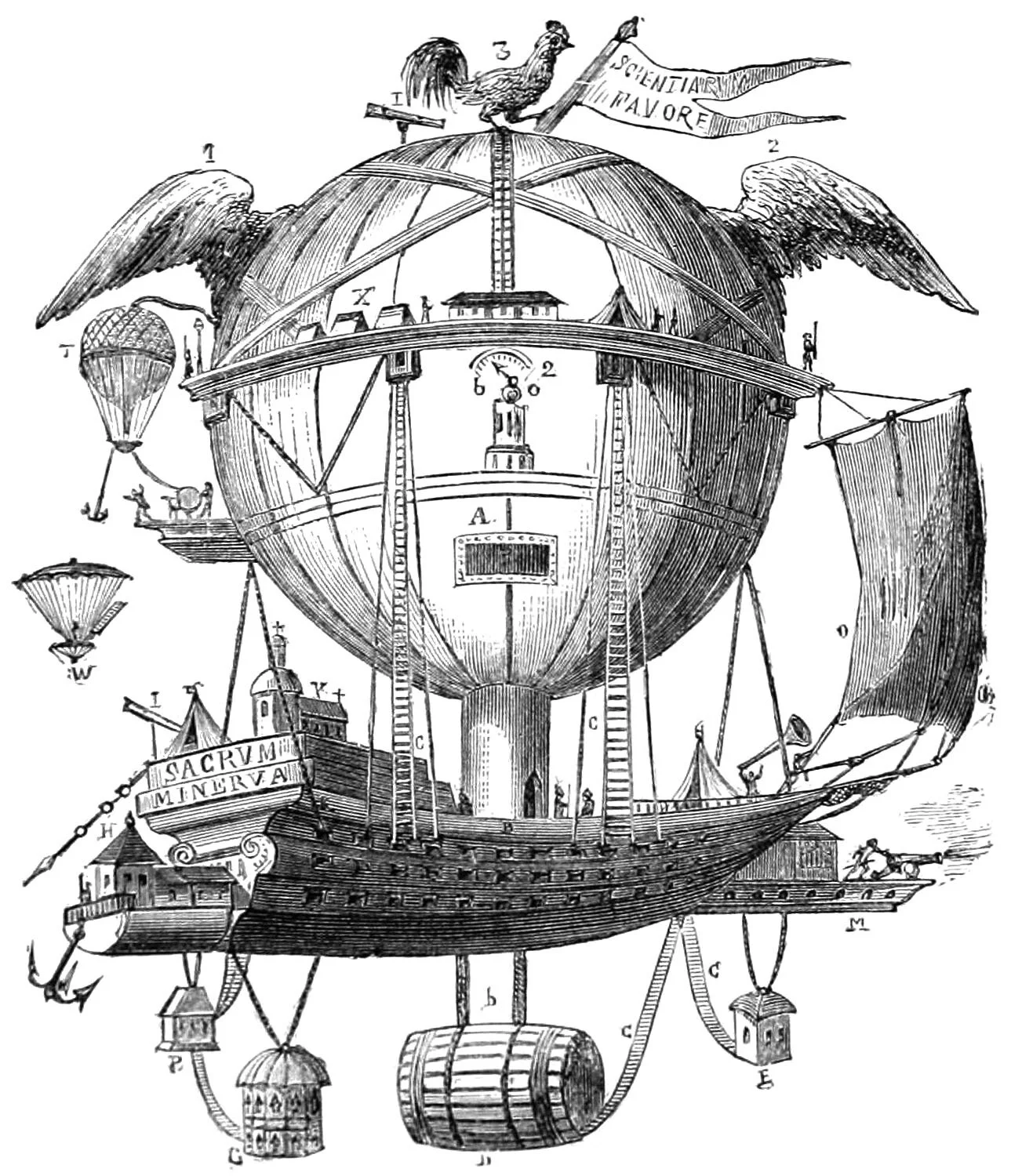
A fanciful illustration of a flying ship, drawn in black and white. The boat is shaped like an old-fashioned frigate, held up by a large balloon with a cockerel on top. A beer keg sits underneath the boat, while on the deck there is a church, tents, people with telescopes, a man with a cannon, and smaller balloons taking off from the side.
Would the ship get lighter over time as the beer was consumed? Credit: Wonderful Balloon Ascents via Wikimedia Commons

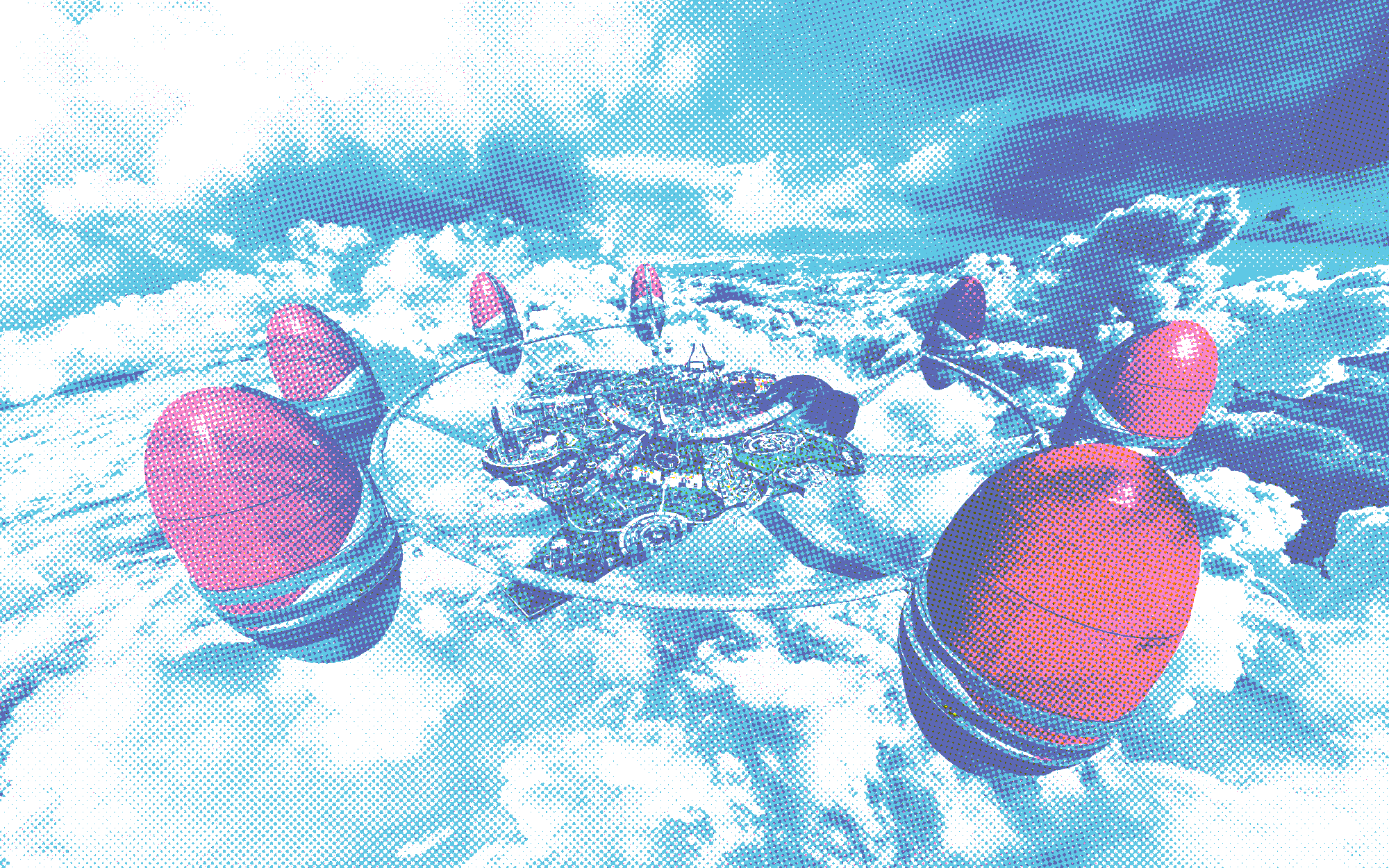
Fast-forward to the 2020s, and people are still dreaming up fantastical flying cities filled with scientists - this time, in video game form. In the battle royale game Apex Legends, you can find a map called Olympus: a futuristic flying city with a Greek name, held up by balloons, designed to be inhabited by scientists and artists. It’s another utopian vision, another dream of what the future could be. Except by the time we view Olympus in-game, things have already gone awry. There’s a giant energy bubble on one end of the map, the city has been abandoned, and our very presence there confirms that something has gone terribly wrong. We’re participants in a televised blood sport, and we’re all battling to the death. It’s not what I'd call living the dream

Being confronted by a failed utopia, naturally, leads to all sorts of questions about where things went wrong. And sure enough, if you dig a little deeper into Olympus, you’ll discover a story that touches on class dynamics, corporate philanthropy, and the objectivity of science. That level of storytelling may seem surprising, given that Apex Legends is a fast-paced shooter where you can’t exactly stop and smell the roses. (If you do, you’re likely to lose your head to a sniper bullet.) Yet developer Respawn has made consistent efforts to world-build by sprinkling lore snippets throughout the game, and has baked hints about Olympus’ background into the very design of the map. The idea behind this, of course, is to create a rich world and complex backstories for Apex Legends' cast of characters. But why use Olympus as a location? And what is the message behind this failed utopia? 

The mountain at the centre of Olympus, which is half-industrial and half-natural. The rock wall disguises a giant turbine. In the distance are lush green triangles of green turf, while storm clouds linger in the sky.

There’s a long history of doomed flying utopias in the arts. Some of the benefits of using this imagery are obvious: a flying city immediately brings up themes of technological advancement, along with Icarian imagery of flying too close to the sun. Verticality also serves as a useful tool for presenting class structures - if a group of people can fly above everyone else, that brings them power over others. In the 1726 book Gulliver’s Travels by Jonathan Swift, a flying island called Laputa hovers over the kingdom of Balnibarbi. The king uses his flying island as a weapon to rule over his citizens below, while his court of scientists and philosophers fritter away their days by focusing entirely on “music and mathematics”. The island is a satirisation of detached intellectualism, with Swift criticising how the pursuit of science for science’s sake leads to alienation from authentic human existence, and wastes resources that could help regular people. The flying island imagery aids the presentation of themes including technological advancement, abuse of power, and detachment from the (quite literally) down-to-earth people below. 

Yet the name Laputa may be more familiar to many from the Studio Ghibli film Laputa: Castle in the Sky, which drew inspiration from Swift’s work. The depiction of this utopia is a little different: abandoned by its initial inhabitants, the city is tended by robots, and eventually becomes an ecological paradise. Technology itself is not presented as a problem on Laputa - humans and their violent tendencies are. Things only unravel when humans seek to use Laputa’s doomsday weapons, resulting in the island floating off into the upper atmosphere - a sign that current society is undeserving of such a utopia. Again, this flying city tackles notions of technological advancement, concluding that technology itself isn’t evil - but human violence can corrupt it. 

The floating island of Laputa from Studio Ghibli's film of the same name. It has several tiers of castle stone, and at the top is a cluster of white buildings with a giant tree. The bottom is rounded, and looks sci-fi.
Levitating cities bring forth ideas of the sublime, something that transcends humanity. They are also highly visible, essentially ‘held up’ as an example of how to live. Credit: Studio Ghibli

The transient nature of flying cities, meanwhile, lends itself to another theme: libertarian desires to break free from the rules of old society. Due to their ability to move, flying cities present an opportunity to establish entirely new and isolated societies... for better or worse. The video game BioShock Infinite’s city of Columbia is an example of this: the city was intended to be a utopia for Americans, constructed as a sort of ‘world fair’ to promote ideals of American exceptionalism. It eventually secedes from the United States, however, falling under a white supremacist regime that takes things to further racist extremes. As it turns out, this utopia was built upon flawed principles from the start (to cover up American wrongdoings). And while this walled garden was a utopia for some, it excluded and actively trampled on others to create this new society. 

These themes of hubris, detachment, class inequality and technology are frequently explored in depictions of failed flying utopias, each work using these imaginary locations to highlight problems with current-day society, or to muse on things that are holding us back from reaching a utopia. Apex Legends similarly fits into this tradition, retreading many of these familiar patterns - yet it also brings a unique perspective to the table, offering an interpretation that feels particularly contemporary. So exactly what sort of society was Olympus intended to be? Something flawed from the beginning, something tainted by an outside influence, or something actually worth aspiring to? 

The city of Columbia from Bioshock Infinite, a stone statue is in the centre, with white stone regency buildings surrounding it. In the foreground a rollercoaster-style cart rumbles towards the player, while in the distance other floating islands can be seen, held aloft by giant propellers.
Many apparent utopias actually bear dystopian aspects, serving as allegories for what could happen if elements of present-day society were taken to their worst extremes. 

Take a stroll through the Olympus, and the first thing you’ll notice is just how vibrant and colourful the place is. There are pink cherry blossoms everywhere, lush green lawns, and giant inflatable balloons in the distance. Neatly-designed pathways lead you between areas, while there are even bike sheds and flying minibuses. Public transport options? We must be in heaven. The enormous hydroponics towers suggest Olympus might have been self-sufficient, hinting at a more balanced and futuristic relationship between humans and their food sources. This hopeful landscape provides an important glimpse at what could have been, making the fact you’re now running around there with a shotgun feel all the more tragic. It’s easy to imagine how scientists could have lived on Olympus, busily working away on projects to improve the world. Now, with vast areas and sightlines (mostly) devoid of humans, the sense of space serves to make Olympus feel abandoned and weirdly eerie. 

After a little while roaming around, you’ll notice the ominous storm clouds in the distance, troubling the peaceful blue sky overhead. This sense of something being off is embedded into much of Olympus’ environmental design. Behind those pretty natural facades are brutish, industrial machines which are necessary to keep the city afloat. The elegant mountain at the centre disguises a giant turbine, while the city’s underbelly is a mish-mash of metal structures - the kind you might expect to find Luke Skywalker dangling from. Covering all of this is an angular grass lawn, divided into triangles. These efforts to hide the uglier parts of Olympus, along with the pervasive sense of artificiality in its ‘natural’ features, are somehow unsettling. You’re reminded that this is all constructed, all fake, and perhaps an effort to disguise an unpleasant truth with pretty set-dressing. Some of the city’s plazas and apartment buildings, meanwhile, have that opulent sheen you might expect to find in a Dubai hotel. Or a hotel in Hong Kong, Singapore or Tokyo, really. Aside from some nods to Japanese design with bonsais and curved doorways, it’s the sort of globalised style that could fit into any metropolis - that sleek modern look that reads of everywhere and nowhere. It suits Olympus perfectly, as a newly-constructed city for elites, with no history of its own. And judging by all the gold trim and luxurious properties at Autumn Estates and Golden Gardens, it’s evident that Olympus is backed by serious money. 

A top-down view of Olympus' terrain, showing a patchwork of turf triangles, and clear gaps in-between areas to display the sky below. A cluster of homes called Autumn Estates can be seen on the left, while on the right are the vast residential Oasis tower blocks.

Then there are the more obvious clues about the calamities that have befallen Olympus: the giant bubble of energy, the infected ship that arrived in Season 9, and the sudden appearance of a city below Olympus in Season 12. Respawn’s narrative approach for Apex Legends has been to release snippets of lore through trailers, comics, quests and in-game rewards - allowing players to piece together clues to understand the backstory. To give a quick overview: Olympus was originally founded by a “billionaire humanitarian” called Lillian Peck, with the city intended to be a haven for scientists and artists. They produced multiple breakthroughs, even solving an energy crisis by discovering an element called branthium. But this success also proved to be Olympus’ downfall. A mercenary group attempted to steal the element, prompting the team to trigger a self-destruct sequence that killed the scientists and produced the unstable energy bubble. The remaining academics then left the city, marking the start of Olympus’ decline: the city was used as a luxury resort for 40 years, before being turned into an arena for the Apex games. During the course of the games, an evil-doer attempted to use Olympus as a weapon, hacking into the island’s systems to drop it on the city of Malta. Thankfully, the central fan kicked in to keep the island afloat, sparing everyone from a nuclear-level disaster. Yet the incident once again damaged Olympus, marking its continued fall from grace.  

A giant blue bubble of energy sits atop a green rolling hill, with pink cherry blossoms in the foreground. The energy bubble is connected to a giant metal pipe, which has become twisted and damaged.

Compared to Gulliver’s Travels, Laputa and BioShock Infinite, the criticisms being made by Apex Legends’ Olympus are perhaps less overt. With the attempted theft of the branthium and subsequent explosion, there’s definite commentary on how human greed and individual interests can spoil projects intended to benefit all. (It’s worth noting, too, that Apex Legends is set within the same universe as the Titanfall games, where themes of corporate colonialism and exploitation are regularly explored.) The attempt to use Olympus as a weapon, meanwhile, echoes Laputa’s conclusions that technology is often corrupted by human violence.

Perhaps most importantly, however, Olympus exposes an arrogant train of thought: the notion that science can be totally separated from the society surrounding it. There’s a commonly-held belief stemming from the Enlightenment period that science is inherently good, objective, apolitical, and immune to larger societal forces. Yet as social constructivists would argue, this is an illusion, and believing it can make you blind to underlying power dynamics. Take the International Space Station as an example: created for the express purpose of neutral scientific cooperation, humanity has benefited from numerous discoveries from the station, but its operations have always been heavily dictated by geopolitics - determining who is allowed on board and how the equipment is used. With access limited to a select few global powers, it’s evident that political interests play a role in the ISS’s scientific mission.

The city of Malta that formed part of the skybox for Apex Legends season 9. A cyberpunk-style grid city can be seen, along with flying traffic in lines through the air. The clouds surrounding it look dirty and grey.
Brought low over the city of Malta, Olympus’ Season 12 skybox highlights the city's fall from grace - tumbling from lofty ideals closer to the messy reality below. 

In Olympus’ case, the city was designed to be ‘elevated’ from the planet below, far above the messiness and politics of society. As a safe haven for scientists and academics, Olympus was intended to be a neutral place to work for the common good. Details about Olympus’ origins, however, raise questions about exactly how separate it was from the machinations of those below. Where did philanthropist founder Lillian Peck get her billions from, exactly? Corporate philanthropy is often used to deflect criticism about negative aspects of a person’s business interests - and there are plenty of unanswered questions about Peck’s background.

There’s evidence that other corporate interests were involved in Olympus, too, with a lore book mentioning that Silva Pharmaceuticals directly invested in the branthium project and became significantly wealthy as a result. Even without this knowledge, the opulent design of the map makes it clear that the city was funded by, and catered to, the extremely wealthy. The absence of working-class people or structures on Olympus underlines that this was a gated community for elites: a utopia for some, but not for most. Olympus wasn’t a purely philanthropic endeavour, and was very much tied to the economic systems and class structures of the planet it floated above. 

The storyline also reveals a surprising level of naivety among the scientific team, in that a highly valuable resource was not properly protected - a mistake that resulted in the destruction of the utopia. Being complacent to Olympus’ place within a ruthlessly capitalistic society meant the team was unprepared to counter external threats when they arrived. Despite this, the scientists did manage to solve the energy crisis, meaning that some good was able to come of the project despite its messy ending. Here, I believe, is the message at the heart of Olympus. The lesson is that striving towards a utopia is not necessarily a bad thing, with the pursuit of these ideals prompting positive changes like social reform or scientific breakthroughs. You cannot, however, allow a utopian vision to make you ignorant to underlying social dynamics. In Olympus’ case, the promise of ‘scientific progress’ was used for philanthropic whitewashing and the re-assertion of existing class structures. Overconfidence in the universal goodness of science - and overconfidence in the apparent separation of the city from the rest of society - led to ignorance of external threats, ultimately sealing the city’s downfall. 

Several giant, boxy space ships float in the air above Olympus, with large tentacle vines grabbing the golden skyscraper of Bonsai Plaza and damaging its exterior. In the distance is a deep blue skybox with bright white clouds and stars.
As Apex Legends’ seasons rumble on, we observe Olympus’ decline in real time, witnessing how different actors seek to use Olympus for their own selfish interests. What further calamities could be in store for this troubled city? Credit: Respawn Entertainment

Like the balloons holding it afloat, Olympus was once a hopeful vision of the future - one that proved to be fragile, and temporary. As a failed floating utopia, it fits neatly into the tradition of using flying cities to explore current societal problems; and while it retreads familiar themes, Apex Legends’ interpretation feels particularly specific to the times we live in. In recent years, we’ve seen Silicon Valley tech billionaires use philanthropic initiatives for PR purposes, while also lobbying politicians to decrease corporate tax rates and remove regulations. Billionaires have pushed ideas of techno-utopian futures in order to influence government policy - convincing politicians that science and technology can solve all our problems, and that the planet can be polluted in the short-term to reach this ideal. Even the name Olympus - the luxurious mountaintop home of the gods in Greek mythology - draws parallels with how the super rich seek to squirrel themselves away in gated communities, separate and elevated from the commoners below, securing themselves from the effects of climate disasters they helped create by hiding in yachts, bunkers and colonies on Mars. As the ultrarich become ever-more interested in using their resources to gain influence, Apex Legends’ Olympus encourages us to remain suspicious of corporate philanthropy and techno-utopias, reminding us to question simplistic claims of projects for the ‘good of all’ to ask whether ulterior motives could be involved.

Despite these pointed criticisms, the beauty and optimism of Olympus’ map design hints that there was something worth striving towards here. There’s a sense of loss, a sense that the project once did some good. Like Robert’s flying balloon La Minerve, Olympus suggests that there’s nothing wrong with aspiring towards a utopia, as doing so can inspire positive change in our current world. Yet in both our world and Apex Legends, utopian visions can easily become warped or dangerous. Unquestioning belief in these visions allows them to be used for ill, resulting in social structures that are unequal or exclusionary. A perfect society is impossible, as everyone has an individual interpretation of what this constitutes - meaning we will never build a true utopia. Perhaps the best approach, then, is to take the progressive optimism of utopian visions, and combine it with a sense of caution. After all, it's admirable to dream of a better world: but we must remember not to leave our heads in the clouds.

Special thanks to the R5 Reloaded project for their work archiving Olympus' original Season 7 map, and Steam user Hoxdolum for their work extracting the Season 9 Olympus skybox.


For further dreamy pieces about video game design, sign up for the free Eteo Archetypes newsletter. You'll get the weekly Archetypes article in your inbox, plus important studio announcements from Eteo.

Check out the Eteo Discord server if you want to discuss this piece and other Archetypes articles in a friendly and thoughtful environment.