
Official game art for Skies of Arcadia, showing the cast standing on board a flying boat.
Flying Cities

Words by  Gareth Damian Martin

Flying Cities

The Blue-Sky Optimism of Skies of Arcadia

Words by  Gareth Damian Martin

Each time I write it, the phrase 'Sega blue skies' evokes so many sensations in me. It may be, for some people, a cliché – a meaningless bit of nostalgic fiction. But back in 2000 those Sega blue skies were a real feeling. They were symbolic of the optimism of the rapid technological leaps of console gaming and the utopic consumerism of Japanese electronics, which the buoyant and bold vision that the Dreamcast – with its futuristic VMUs and charming spiral logo – seemed to be a herald of. Even in the not-so-futuristic setting of my friend's dingy house in the North of England, in his older brother’s room (the type who had the disposable income to splurge on the new console), those Sega blue skies shone brightly, and no more brightly than in Skies of Arcadia.

In the JRPG Skies of Arcadia the skies are, as you might expect, ubiquitous – they describe the limits of Sky Pirates’ globe, just as they do ours. Everywhere you look there’s sky: filtering through the windows of your airship’s galleon-style bridge, surrounding the floating rock that an ancient monolith rises from, or acting as a windswept backdrop for two flying man-o-wars to exchange cannon fire. This is very intentional, with joint developers Overworks and AM2 (who could be argued were the originators of the Sega blue sky) never missing an opportunity to draw your eyes to the horizon. 
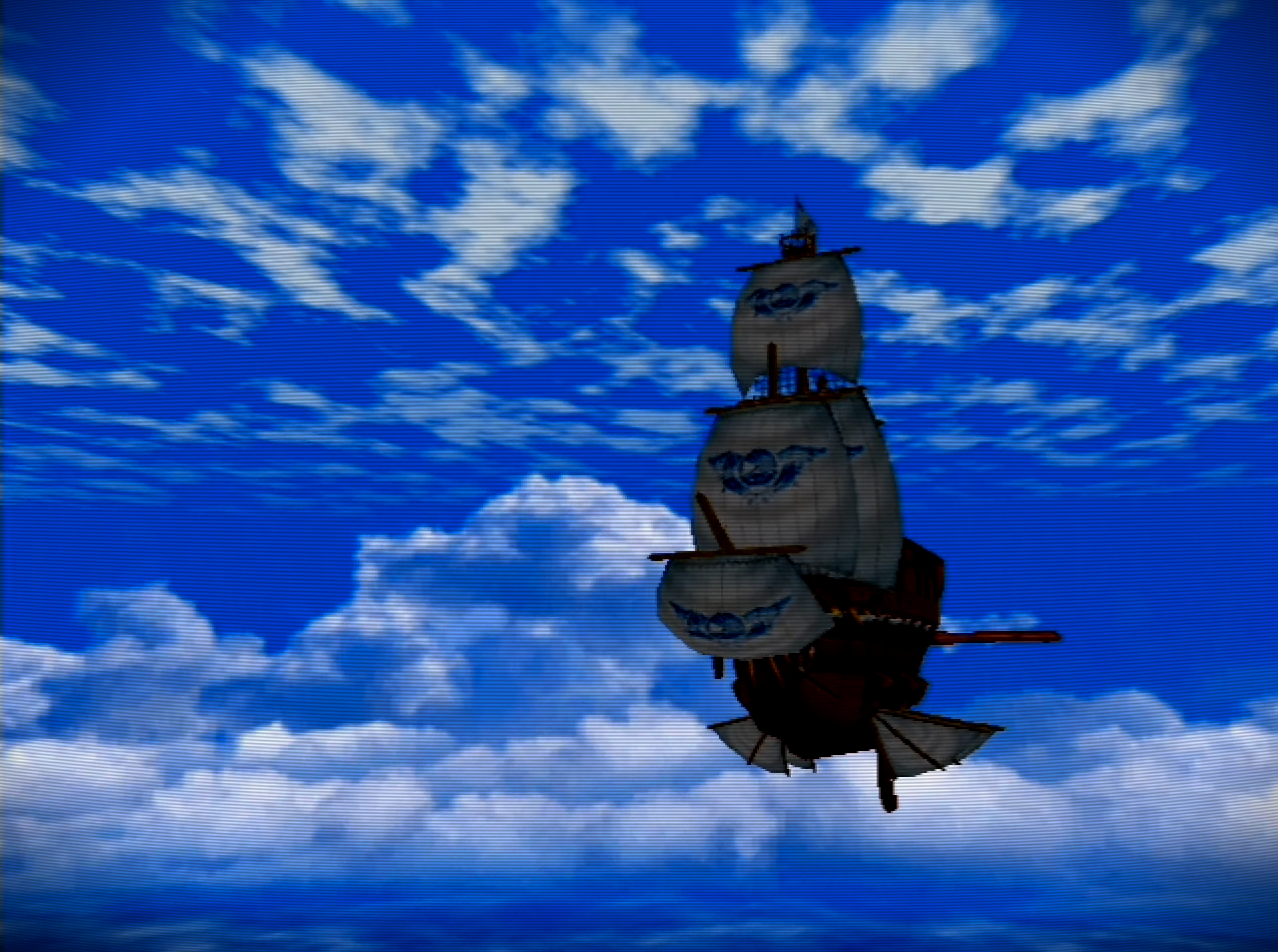
An old-fashioned tall ship flies through a blue sky filled with white fluffy clouds.

You might go through a doorway and find yourself clambering down a ladder on the side of an airship, clouds whipping by. You might unlock a stone door deep in a temple and find yourself on the underside of its floating island, crossing ancient walkways suspended above infinite blue. Dungeon floors fall away to reveal only sky, while every balcony or walkway is a chance to turn the screen cyan. The sky is always there, behind everything, like those blue skies we know are waiting for us every day on Earth if we could only get up above the clouds.

This design pattern of limited, almost cosy, space that offers windows out towards an infinite horizon, is explored so thoroughly in Skies of Arcadia that it is hard to pick a exemplar (or an archetype, so to speak) but I find myself coming back to the humble hub of Sailor's Island again and again. One wide thoroughfare, across two small rocks, linked with a bridge, it seems fairly humble on first appearance. It barely even qualifies as a town, offering little more than a tavern, a Sailor's Guild, a couple of merchants, and an inn. But there’s an expert control of sightlines that typifies the game's careful and lovingly-crafted architecture in this seven-building settlement. 

The view down the main street of Sailor's Island, showing a lighthouse and merchant buildings.

The entrance is flanked by the Sailor’s Guild and tavern, both with classic wood frame exteriors, and are full of parchment globes, dusty bookshelves, grog bottles, and other piratical props. But it’s the view from this entry square, down the main street, that I am interested in. The whole island is organised around it, and it descends onto a second rock, with a merchant and an inn on each side, and then beyond – tastefully offset from the centre – a lighthouse. It’s an elegant composition, with diagonals leading your eyes across the blue sky that backs it all. And, with this controlled view, we might think ourselves on solid land, or even a cliffside, not floating improbably on rocks. This is what is so enjoyable about Sailor’s Island, because as we descend into its architecture, it plays with this sense of perception. 

While Sailor’s Island’s linear composition, from entrance to lighthouse and back again, suggests a clifftop pirate town, it is the pathways cut across it that play with its floating nature. Gaps between the rocks, bridges and balconies create a series of views that are perpendicular to the main flow of the town, and reveal and frame those signature skies. Each time we cut left or right, we find ourselves looking down through gaps – or up past railings – at cotton-wool clouds and the blue beyond. It’s surprising how such a simple town-plan leads to so many carefully-framed views that play with the central conceit of Sailor’s Island: that of being a recognisable ‘grounded’ settlement, and of simultaneously being a fantastical flying object. This conceit lies at the heart of what is attractive about Skies of Arcadia’s world, and more widely the entire flying city aesthetic that we might find elsewhere in the work of Studio Ghibli or the Gravity Rush series. Taking objects not “meant” to be flying, and elevating them is a simple and yet surprisingly effective trick. 

In Skies of Arcadia, this plays out through the airship – a boat sailing in sky not sea – and airships are something that Sailor’s Isle uses to great effect. To add to its carefully-framed views the game brings a set of orbiting craft that jollily make their way around the island. You can’t look down one of its alleys, towards the horizon, without one of these charmingly toy-like shapes crossing your vision. They bring another playful element of ‘elevation’ to the location, once again activating the excitement of the island's central visual conceit. Bobbing along in rhythm to the incessantly jaunty theme that Yutaka Minobe penned for the island, these ships, along with a set of ‘skyfish’ that dance around the lighthouse, make this mostly static town feel at the heart of the bustling sky pirate world. 

No visit to Sailor's Island is complete without one final act: scaling the lighthouse that all its well-positioned sightlines lead towards. One final bridge leads us to its island, and a quick ascent up a ladder reveals a viewing platform, built for one of my favourite touches in Skies of Arcadia, its first-person view. Allowing you to jump behind the eyes of protagonist Vyse, it may be there to allow you to spy secrets, but it also does a wonderful job of putting you in this world. And the lighthouse, with its panoramic windows, is made for gazing out at the streets below. Unsurprisingly, one of these windows frames the town beautifully, looking down on its terracotta tiles and flagstone streets as if it were a diorama - the route you took to get here easy to spot. It also reveals a few balconies, another layer to the town, that can be accessed from within its simple buildings. But it's the other three windows that draw particular attention, each framing a little rectangle of blue. Each one tempts your eye, as if you might spot some distant location, secret, or ship if you stared out of them long enough. 

The player-character looks out the window at the top of the lighthouse.

Perhaps that’s what makes Sailor’s Island so attractive, the sense of promise that its blue backdrop gives the humble little town. Skies of Arcadia is all about plucky optimism, which makes the eventual failure of its home console (the Dreamcast itself ending Sega’s entire hardware division) slightly ironic. But there’s no place for irony in a blue sky, especially not when a charmingly naive galleon is trundling across it, on the lookout for new adventures. For Skies of Arcadia this optimism is not just a narrative tone, it is baked into its architecture, its art and the ever-shifting cloudscape they hang within. There’s a playfulness to its world that is deeply felt in the architectural games that Sailor's Island stages with its bobbing rocks and balconies, that still, even now, evokes a sense of brighter futures and bold new adventures in me.


Expand your horizons by signing up for the Eteo Archetypes newsletter, where we publish captivating articles like this every week. Subscribe to get the free weekly article delivered straight to your inbox, along with any important studio announcements from Eteo.

You can also sail on over to the Eteo Discord server if you want to discuss this piece and other Archetypes articles in a friendly and thoughtful environment. See you there!