Radios
Nostalgia Power - the Origin and Evolution of Fallout's Pip-Boy Radios
Can you think of a place and time that you associate with a specific song, or album? For me, it’s driving through the streets of Bristol while singing the Gorillaz song Superfast Jellyfish with my sister. (To which, yes, we can repeat every word with all the vocal inflections, thank you.) It’s a strange old thing, as there was nothing particularly remarkable about that day - it was simply a drive back from town. Yet it’s a moment that remains anchored in my mind, bringing back feelings of a carefree summer. It’s an example of the incredible mnemonic power of music, which studies have shown is linked to our implicit memory. In other words: the unconscious absorption of information through our senses, rather than through conscious thought. It’s a process that uses numerous parts of the brain, and elicits strong emotional reactions. This is why neuroscientists have looked to music as a way to help dementia patients, as when our conscious memory becomes damaged, music can bring back vivid memories absorbed through different pathways.
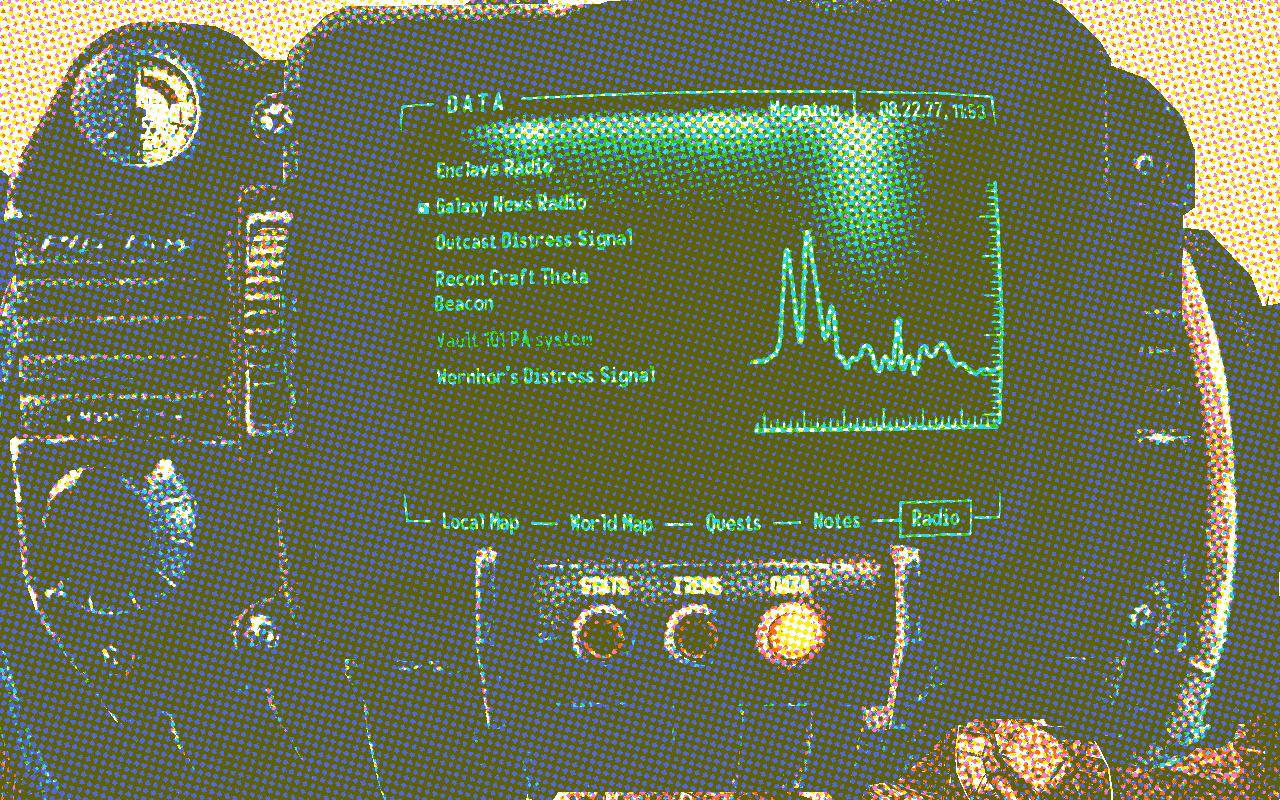
This effect applies, similarly, to memories made within the digital world. I still strongly recall a battle with a deathclaw in Fallout 4, during which my Pip-Boy fortuitously started playing Wagner’s Ride of the Valkyries. It was the perfect accompaniment to my tussle of chainsaws and claws, with the elevated classical music providing ironic juxtaposition to the violence of the situation. Speak to any Fallout fan, in fact, and they’ll recount similar memories tied to specific radio stations or songs from the games. Since Bethesda took control of the Fallout license, the Pip-Boy radio - a mobile radio device that players can switch on manually - has become a core element of the series’ identity, and a beloved source of nostalgia for players. “I feel like it becomes a snapshot of time in your life,” says Mark Lampert, audio director on Fallout 3, Fallout 4, Fallout Shelter and Fallout 76. “So when you hear it now, it instantly takes you back.”

The Fallout series didn’t always have jaunty, 1950s-flavoured radio stations that you could tune into on a whim. The first two games - developed by Interplay/Black Isle Studios with music by Mark Morgan - both used unsettlingly bleak, ambient soundtracks that kept the player on edge. Want to feel unnerved? Just take a listen to the blaring alarms and discordant drones used for Fallout’s ghoul city of the Necropolis. The introduction of Pip-Boy radio stations by Bethesda in Fallout 3 marked a significant shift in the musical makeup of the Fallout games, introducing a more tongue-in-cheek feel to the soundscape. Yet the idea for radios didn’t spring from nowhere: as Lampert tells me, the Pip-Boy radios were inspired by the trailer music from the first two games. Namely, the songs of 1930s vocal group The Ink Spots.
“To the best of my memory, I think [the idea] came from lead designer Emil Pagliarulo and Todd Howard,” Lampert explains. “The studio was much smaller at the time… there may have only been 50 or 60 of us on the development team. And I really feel it was just a conversation. Everyone knew about the vibe that the Fallout one and two introductory trailers leant those games - the classic Ink Spots music and that guitar intro that everyone knows so intimately now. And as best I can recall, it was just [Pagliarulo or Howard] saying ‘what if we had that music in the game?’”
The initial idea was to have this music play from radios found within the game world, Lampert says, until someone suggested integrating them into the player’s Pip-Boy. At which point, the complexity of the concept “exploded”. Questions emerged about how to acquire the music rights, the potential costs of these tracks, and how the radios could function within the strict constraints of music licensing rules. You might be surprised to learn just how much the latter impacted the design of Fallout 3’s radios: Lampert explains that the tracks could only be played in a random order due to the increased licensing costs of allowing the player to select their own music.
“As far as the rights holders are concerned, it would have cost a great deal more to license that material if it was something the player could choose,” Lampert says. “If every track is treated equally, everyone is willing to sell you that music for much cheaper, because one is not favoured over the other.”
The same restriction also determined how music was split between radio stations in Fallout 3’s world. It was decided that one major station (Galaxy News Radio) would play all the licensed tracks, while smaller stations (such as Enclave Radio and Agatha’s Station) would host patriotic and classical music from royalty-free catalogue packs. This meant Bethesda could avoid the legal complications of allowing the player to pick between two fully ‘licensed’ radio stations. “Pretty soon, what starts out as a really fun idea turns into all these little gymnastics,” Lampert adds.
Sure enough, other complications emerged. As many of the 1950s-era artists were no longer alive - with the rights to their master recordings and licenses held by different people - there were difficulties acquiring the rights for some tracks. In one instance, two record companies claimed that the other held the rights to a song. Where these disputes occurred, Bethesda often had no choice but to leave the track out of the mix, with the legal risks of including it being too high. “Thankfully, we found the right person to help us navigate those channels [Chris Parker], and then it was back to the fun part of what era is appropriate for this game,” Lampert adds.

When it came to track selection, the team primarily looked for upbeat Americana from the 40s, 50s and early 60s. Special attention was paid to finding relevant lyrical content - it doesn’t take much to recognise the irony of tracks such as Happy Times and Jolly Days, for instance. And for each of Bethesda’s Fallout games since, songs have been selected to match a game’s location and main story beats. Many of Fallout 4’s songs reference loss and searching - themes appropriate for the protagonists’ search for their child. Fallout 76, meanwhile, has a much more country feel, featuring western swing and iconic songs such as John Denver’s Take Me Home, Country Roads. As Lampert adds, the latter track's release date of 1971 - far beyond the divergence point of Fallout’s world from our own timeline - displays how the team was willing to break its own rules when “the song is so good we have to use it”.

From a sound designer’s perspective, the initial decision to add radios to the Fallout world was a bold one. The introduction of jaunty radio stations marked a significant gear change from the unrelentingly bleak sounds of the original Fallout and its sequel. The random element of the radio playlists, meanwhile, meant relinquishing control over which pieces of music the player would hear at certain points during their adventure. And of course, Fallout 3 features a full, original soundtrack composed by Inon Zur - along with a host of environmental sounds designed to build up a creepy wasteland ambience. Allowing the player to ‘override’ these with the Pip-Boy radio meant risking that the player would miss out on some of the more subtle, atmospheric elements of the game’s sound design. “At first, it bothered me a little as a sound designer that you could flip over to this happy-go-lucky kind of vibe,” Lampert says. “But then I got over it, because all the power is in the player’s hands. There’s a lot of qualities like that in BGS games… you can sculpt your own experience.”
The introduction of radios - technically a diegetic sound within Fallout 3’s world, with the music emanating from the player’s arm - therefore brought new roleplaying opportunities to Fallout’s sound design. Critical to this was the ability to switch the radios off. “The players that want those tunes on all the time can leave them on all the time, and it’s as simple as going ‘zip’ when you want to use your ears in a more stealthy situation,” Lampert elaborates. “I like that, as long as the player has control over it and we aren’t forcing it on them.” Indeed, player accounts of their own experiences with Fallout’s radios often detail how they use the radios as a roleplaying device: only tuning in when they visit towns to ‘catch up on news’, and turning them off when in dangerous enemy territory. After all, you don’t want an enemy raider joining in for a surprise sing-along of Butcher Pete.
The random element of the radio playlists, meanwhile, proved to be a surprising strength, creating spontaneous experiences unique to each playthrough. As I found out through my own deathclaw encounter, when the stars align and the right track plays at the right time, it feels truly serendipitous. “People will all have their little moments,” Lampert says, recounting his own memory of a misty laser battle accompanied by triumphant classical music. “If that’s memorable for me, after having played the game for 1000 hours… it certainly would be good for someone else.”
Rather than distracting from the underlying soundtrack, Fallout 3’s radios also act as a fascinating contrast to the sombre feel of the OST and environmental sounds. The cheery radio stations are a useful tool when heading into dangerous territory, and can provide you with a much-needed confidence boost. Switch the Pip-Boy radio off, however, and you're suddenly confronted by the desolation of the world's soundscape. In the relative silence, you become aware of all the creaks and pops inside each abandoned building, shifting your gameplay experience from action-shooter to horror. The wasteland feels eerier than ever, and the contrast between the radios and underlying sound mix emphasises just how far civilization has fallen. As Lampert adds, however, the audio team is "never going to leave you in digital silence - the player is never totally alone in that sense."
Perhaps most crucially, Fallout’s radios bring a feeling of companionship when wandering the wastes. Many of the radio stations are presented by a dedicated host, who each supply the player with useful narrative information. These titbits help orient the player within the world: Three-Dog’s mockery of the Enclave Radio station, for instance, helps paint a picture of Fallout 3’s opposing factions. With the games tracking quest completion and player choices, the radio narrators also became an effective way to reflect the player’s decisions back at them. Giving the player feedback in this way allows them to feel like their decisions are making an impact on the world - acting as something of a moral barometer, with the hosts giving their own opinions on matters. (If you start slaughtering innocent wastelanders, prepare for a long-distance scolding from Three-Dog.) Fallout 4 took this reactivity a step further by allowing the player to complete a quest that gives Travis - the awkward host of Diamond City Radio - a major confidence boost, with the potential for him to adopt a suave persona and whole new set of lines.
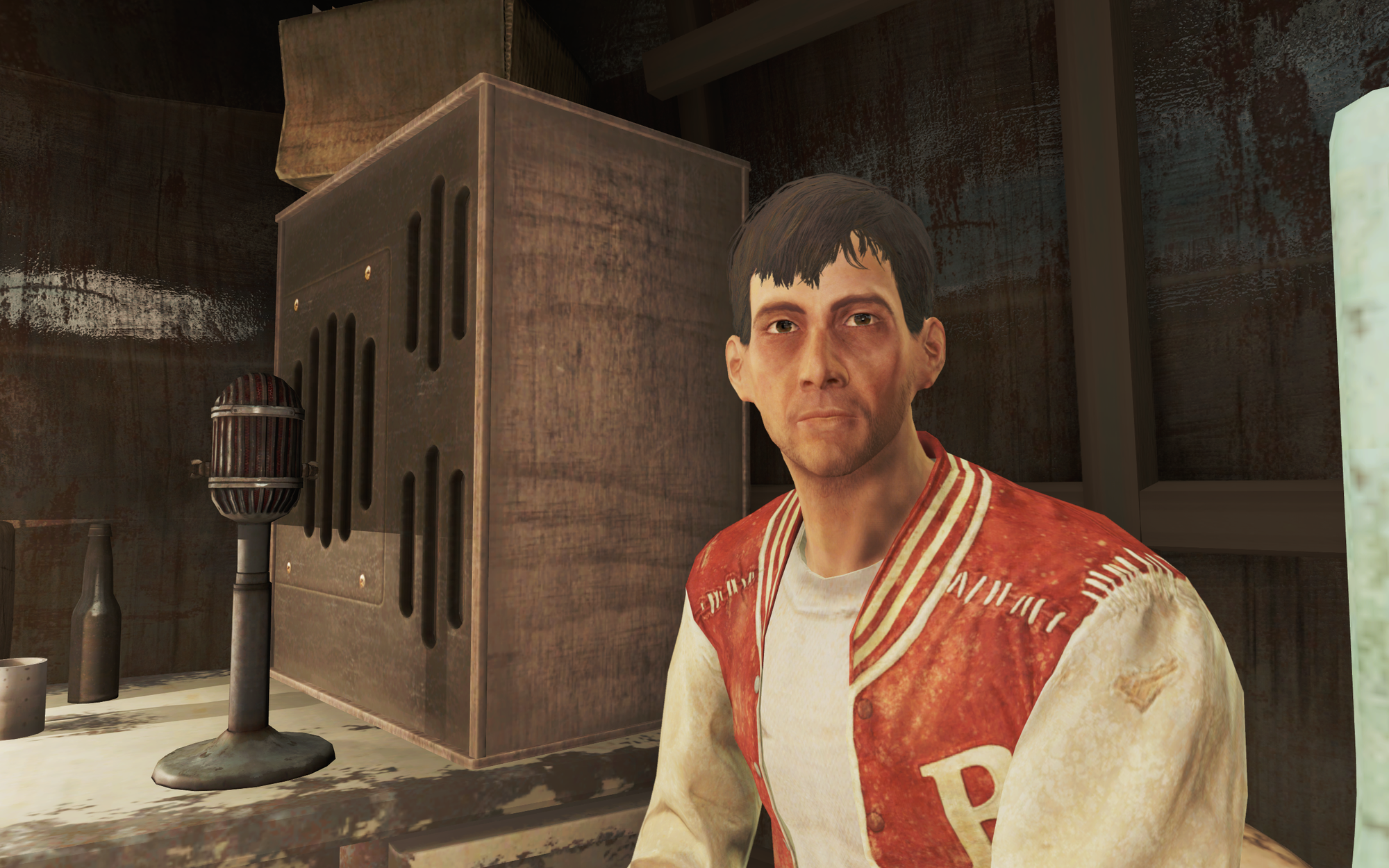
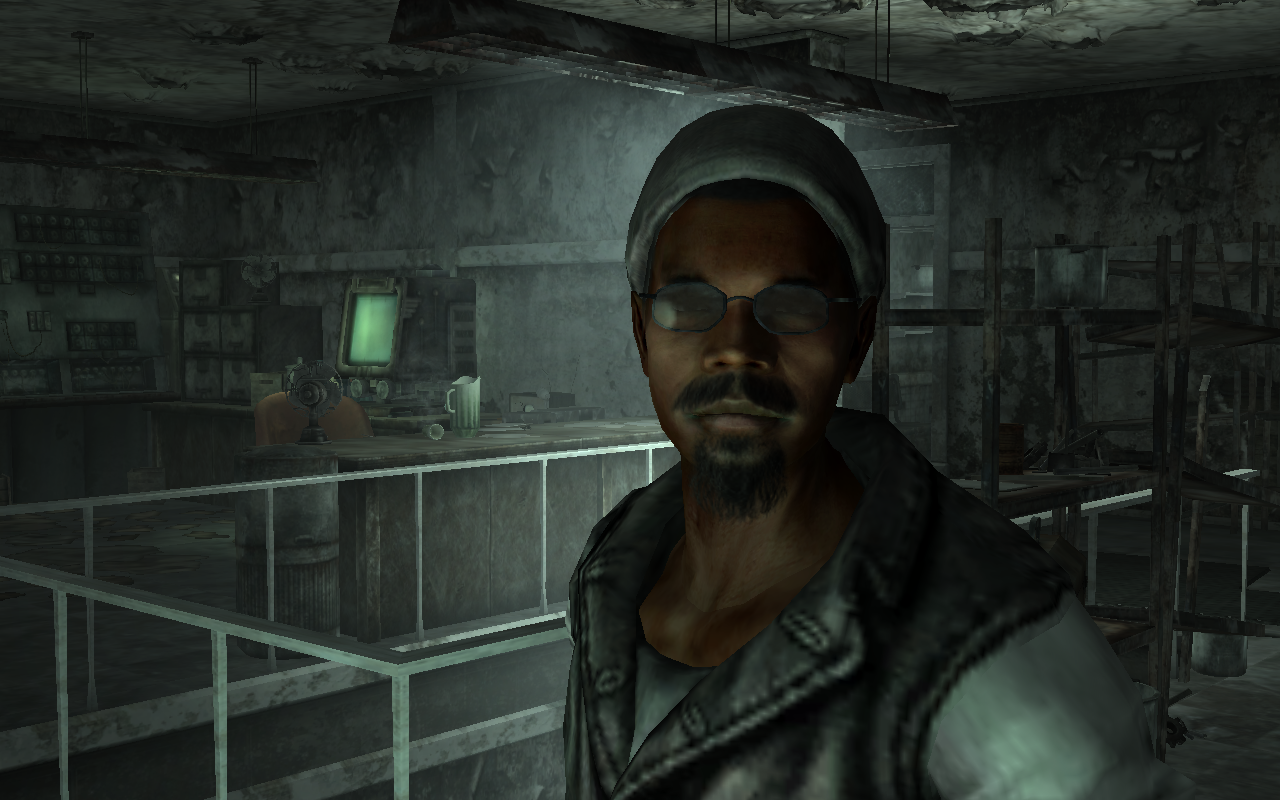
Lampert explains that using the DJ as an omniscient narrator was “too good of an opportunity to pass up”. Pictured: Travis Miles, voiced by Brendan Hunt, and Three Dog, voiced by Erik Dellums.
Lampert tells me that while scripts and character descriptions had been written for the radio hosts, the voice actors were given plenty of freedom to bring their own interpretations to the table. In particular, Lampert encouraged them to take liberties with non-verbal noises such as grunts and groans. Three Dog’s famous howling was improvised in an audition (“I think [Erik Dellums] enjoyed it,” Lampert says), while the vibe of Travis Miles’ character was similarly ad-libbed in a blind audition. “I think [Brendan Hunt] had a description of this guy’s very self-effacing and has no confidence,” Lampert recounts. “And in the audition, he’s screwing up lines, intentionally getting mad at himself, and you can hear him knocking over stuff in the room. Like - man, this guy’s nuts. Whatever we had in our heads before that, he did something very different.”
The team would then take these larger-than-life performances, and reel them in a little. “As Todd Howard would say, it’s better to go too far and do too much… don’t try things in small little incremental stages, because nobody will feel the difference,” says Lampert. “If a [voice actor] wants to add something - and it’s not changing the meaning, or going to confuse the player… we should let them do that, especially if it makes sense for the character. And then they start having fun on the mic, and you get really good performances that way.”
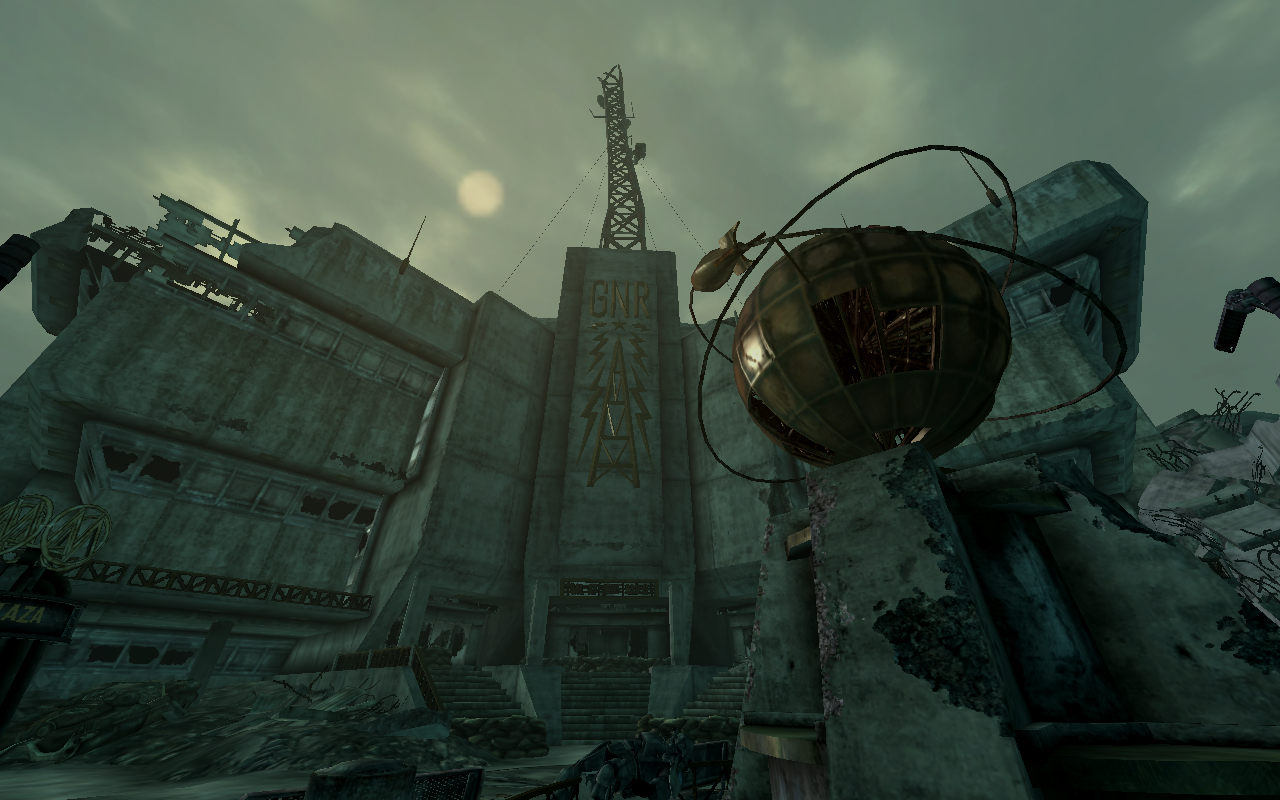
Once the Pip-Boy radio had been introduced in Fallout 3, Lampert notes, there was “no way we weren’t going to do it again.” The radio became a fixture of Bethesda’s Fallout games, with Obsidian also bringing a Vegas flavour to the radio stations in Fallout: New Vegas. With each new game, Bethesda would introduce a slightly new music genre, while bringing along a handful of songs from previous games to create some instant nostalgia.
The team also continued to expand the use of the radio in quest design, with Fallout 76’s Wastelanders update featuring the Overseer’s Broadcast to beckon players towards a new main quest. When Fallout 76 initially launched without a DJ for its main station, it highlighted just how important this narrator role had become for the series. “We missed having the DJ not just for the voice and the back announcing, but because it was this quest mechanic - a way to reference the player’s actions and exploits and failures,” says Lampert. (Indeed, from my own experiences playing Fallout 76 through its various updates, the introduction of radio host Julie had a huge impact in making Appalachia feel inhabited - with exploration made more enticing now that hints were being dropped about what could be found in the wastes.)
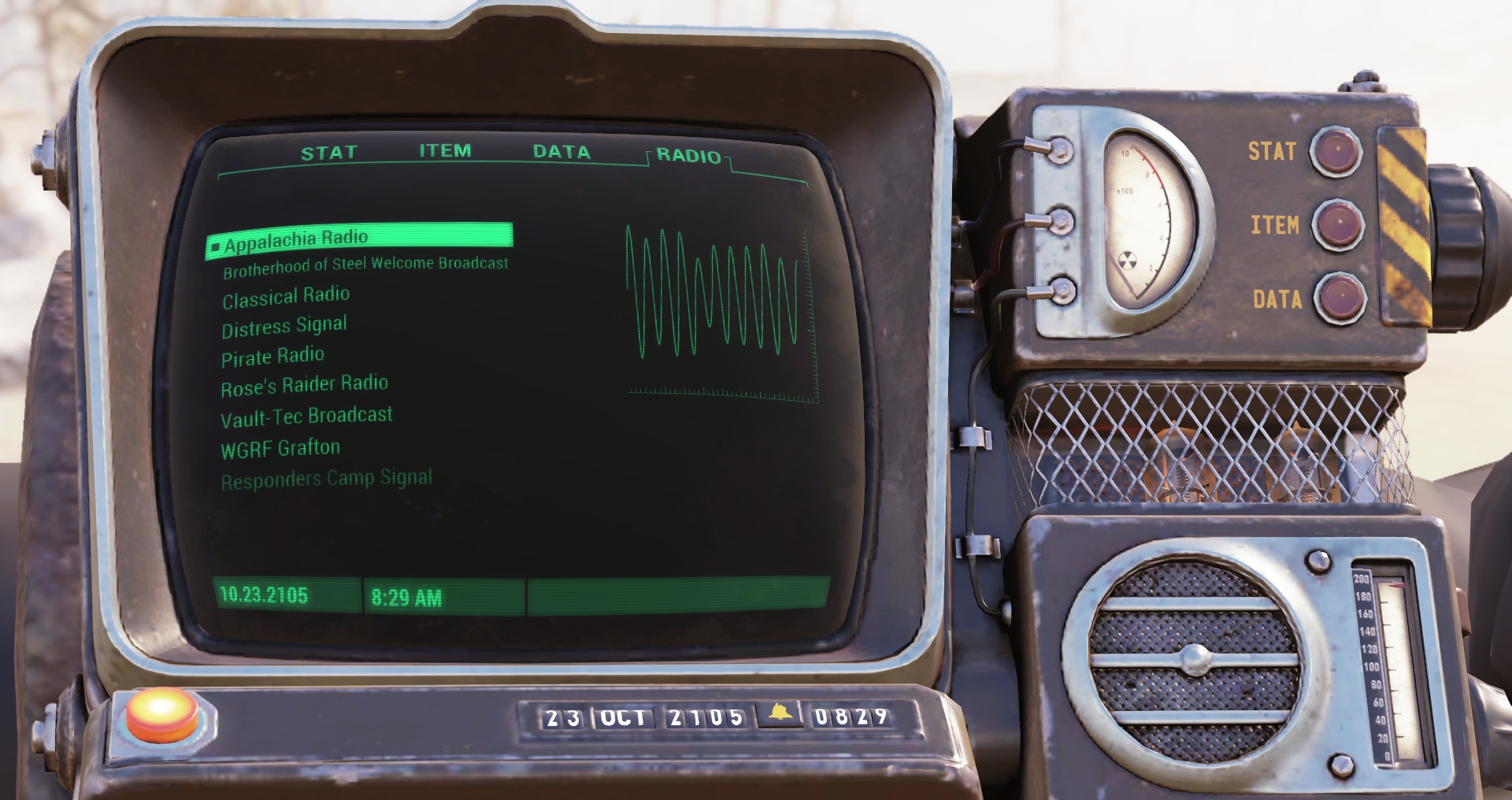
Reflecting on why the Pip-Boy radios seem to resonate so much with players, Lampert attributes their staying power to the creative decision made in the first two Fallout games to use the music of The Ink Spots. And, crucially, the power of having a short tracklist. “That music, to me, if you thought of it as a colour palette - it’s very specific, it’s limited in time,” he says. “I think that limitation is what gives it power, for the listener. Going back to Fallout 3… that came out in 2008, so a lot of people were in junior high, middle school, high school, when you had more time, and sunk more hours in. You heard that repetition, and you heard it at a time in your life when you were going through big ‘growing up’ experiences and emotional moments. It becomes a snapshot of time in your life, and maybe that’s a big part of it.
“I do the same with music now… if [you] go on a trip somewhere - ideally somewhere you haven’t been, like a road trip, where you can listen to a lot of music - try to wait and buy a new album from an artist you like or someone who’s outright new, and listen to nothing but that during that time. Years later, you can put that stuff on, and to me, that’s as close as you get to time travel.”
This gets to the core of why so many of us feel nostalgic for Fallout’s radios. While there has historically been some grumbling from Fallout fans that the radio stations feel repetitive, it’s actually the limited nature of these tracklists that makes them so memorable. In an era where we have endless Spotify playlists featuring songs of all genres, it’s become increasingly difficult to associate a specific sound with the times we live in. If we want to experience feelings of nostalgia in the future, perhaps we should take Lampert’s advice by listening to albums in full. Not only do these smaller, curated experiences offer a distinct perspective on the world: they might just help you forge memories that last a lifetime.
If this article struck a chord with you, sign up for the weekly Archetypes newsletter. You'll get more excellent articles like this in your inbox, along with important studio announcements from Eteo - all for free.
Join the Eteo Discord server if you want to discuss this piece and other Archetypes articles in a friendly and thoughtful environment.